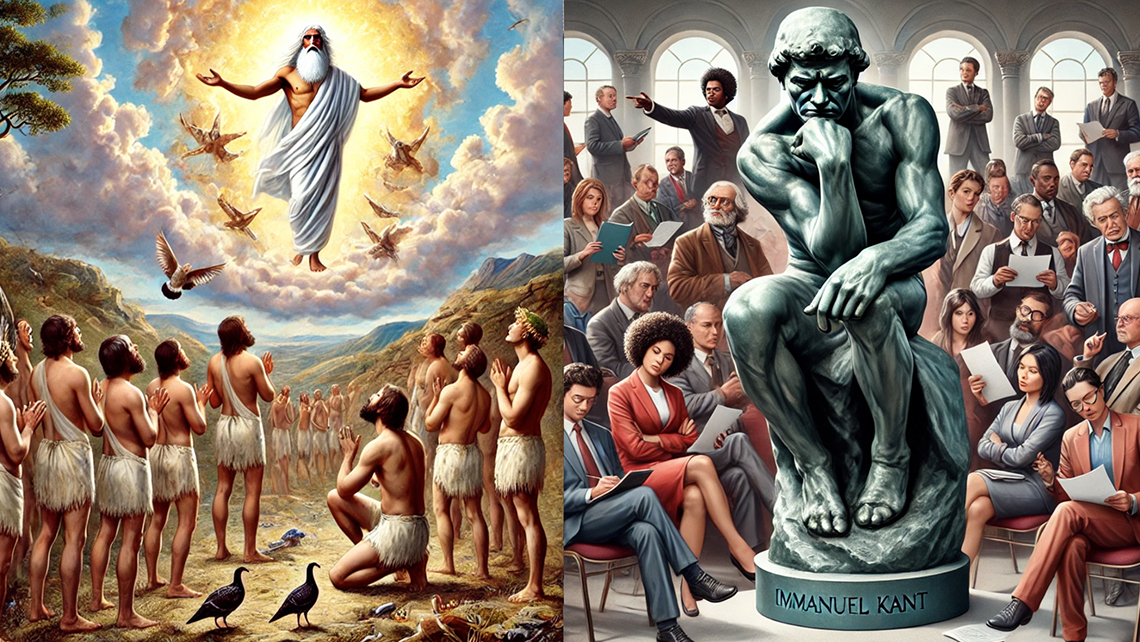
“It ain’t what you don’t know that gets you into trouble. It’s what you know for sure that just ain’t so.” – Mark Twain
The above quote, typically attributed to Twain, notably in the opening frames of the movie “The Big Short,” was more likely to have evolved from a variety of sources[1]. Whatever its origin, it’s a wonderful little slice of folksy wisdom that highlights the pratfalls of certitude. Dogma and doctrine are extremely attractive to us humans as they provide an easy path to certainty, all you have to do is accept them as unshakable truths. Reason and knowledge, however, require us to always be open to the idea we could be mistaken, and we hate that. Dogma offers you something absolute to believe in whereas reason most often serves up our current best explanation, one that might get modified or even replaced by a better one.
Many people see this uncertainty as an Achilles heel, proof that reason and science are always getting it wrong and can’t be trusted. A recent example is mask-wearing to prevent the spread of COVID-19. Early in the pandemic, with the limited evidence we had, our best explanation was that the virus primarily spread through large respiratory droplets, which led to emphasizing surface cleaning, physical distancing and mask wearing. People were instructed to mask up everywhere except at home with their “pod.” Many people were resistant to these mask mandates and attached themselves to one or more of the sumptuous buffet of unfounded mask beliefs that were served up. From masks causing hypoxia due to restricting oxygen intake, to weakening your immune system by keeping cooties out, to masks being part of a grand Government conspiracy to control the masses via embedded 5G chips, not wearing a mask became a political statement that you were standing up for freedom—at least until you had to lie down in a hospital bed connected to a ventilator after contracting COVID-19.
When additional research revealed that the virus also spread through airborne transmission—which was aided by more contagious variants like Delta and Omicron that evolved, public health guidance shifted towards wearing masks indoors and only outdoors if you have symptoms. To mask-haters, these adjustments, which grew out of our increased knowledge of the virus, were seen as “you said that, now you say this, tomorrow you’ll say something else.” The certainty of their chosen crazy mask story was more appealing and comforting than the shifting sands of knowledge and reason.
Faith, belief without evidence[2] is all you need to feel certain that a compelling story you’ve been told or an intuition you came up with is the truth. Knowledge, the best explanation we currently have based on evidence, can’t match the certainty claimed by faith but it is far more likely to be true. Faith and knowledge are both beliefs with the difference between them being evidence.
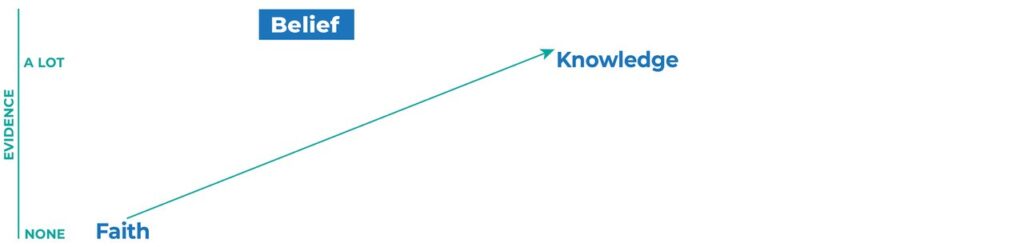
People love to categorize a belief they have as knowledge when it’s actually faith, or at least far closer to the faith side of the belief spectrum. Faith, belief without evidence, is fundamental to many religious beliefs, including Jesus rising from the dead, the angel Gabriel whispering Allah’s words into Mohammed’s ear, God appearing to Moses (albeit with his back turned) to deliver the Ten Commandments and the angel Moroni bestowing the golden plates that became the Book of Mormon upon Joseph Smith–God later cut out the middleman to personally okay Smith taking their teenage maid as the second of his 30 -40 wives. Belief with little or no evidence is not, however, the exclusive domain of religion. For example, many people claim to “know” that genetically modified foods (GMOs) pose health and environmental risks. There is little, if any, evidence to support this belief[1] and there is clear evidence GMO’s reduce starvation[2] and have a positive rather than negative environmental impact[3]. This collective human knowledge typically does little to sway the believers.
“God said it, I believe it, that settles it.” — Ernest Angley[4]
“Doubt is an uncomfortable condition, but certainty is a ridiculous one.” – Voltaire
Embracing reason and knowledge requires humility. You must be humble about the level of your own knowledge even while in awe of the depth and breadth of collective human knowledge. We know that there is an inverse relationship between how much people think they know about a particular subject and how much they actually do. Called the “Dunning-Kruger effect”, after psychologists David Dunning and Justin Kruger who conducted experiments which showed that the less someone knows, the less likely they are to know they don’t know it. While the Dunning-Kruger effect has now been supported by many peer-reviewed studies[5], it has been understood as a human trait for centuries. William Shakespeare noted this phenomenon 400 years ago with “The fool doth think he is wise, but the wise man knows himself to be a fool.[6]” and Bertrand Russell put a finer point on it in the middle of the 20th century when he said “The fundamental cause of the trouble is that in the modern world the stupid are cocksure, while the intelligent are full of doubt.[7]”
“There are known knowns, known unknowns and unknown unknowns”
Donald Rumsfeld was the US Secretary of Defense under George W. Bush and was best known for his enthusiastic support of the false narrative that Iraq possessed weapons of mass destruction to justify the 2003 invasion of Iraq and for the above quote which he made at a 2002 press conference. While his awkward syntax felt incoherent to some people, it revealed an evident truth. Beyond our current body of knowledge, there aren’t just questions we don’t have the answers to, there are also questions we don’t know to ask in the first place. Mr. Rumsfeld’s statement was not only an evident truth but a universal one. Everything has to be either something we know, something we know we don’t know or something we don’t know we don’t know. We must accept not only the limits of our own knowledge, but that there are many things which lie beyond our ability to perceive or comprehend.
Another humbling aspect of knowledge is that the more we know collectively, the more we learn we don’t know. When new knowledge is acquired, it takes a bite out of the unknown but often moves a larger piece from the unknown unknown to the known unknown. We know much more than we did 100, 500 or 1,000 years ago but the increase in what we’ve learned we don’t know has been even greater. We can’t know things we don’t know we don’t know, but the strong historical trend of increasing known unknowns indicates that what we don’t know we don’t know is far from tapped out. The good news is that as our collective knowledge grows so does our ability to leverage that vast canon of knowledge with our tiny slice of it.
Acknowledging what a tiny portion of the totality of human knowledge each of us can possess leads directly to awe and gratitude for the immensity of human knowledge and for how reason built and verified that knowledge so that we can count on it. The difference between individual and collective reason and knowledge, as well as how they work together, will be the subject of next week’s blog post.
[1] The World Health Organization, the American Medical Association, the National Academy of Sciences, and many others have concluded that GMOs are no more risky than non-GMO crops in terms of safety for human consumption and environmental impact.
[2] “Feeding the World One Genetically Modified Tomato at a Time: A Scientific Perspective” — by Christopher Gerry Harvard University 2015
[3] “The Environmental Impact of Genetically Modified Crops” — Morgan Chamberlin Alliance for Science Montana State University
[4] This phrase, popular among American Evangelical Christians, made its first appearance in a sermon delivered by pastor Ernest Angley in the early 1950’s.
[5] “Why the Unskilled Are Unaware: Further Explorations of (Absent) Self-Insight Among the Incompetent” Published Jan 1 2008
[6] The Fool Touchstone from “As You Like It” Act 5, Scene 1.
[7] From “New Hopes for a Changing World” published 1951
[1] Quote Investigator: “The observation has been attributed to several other prominent humorists including Josh Billings (pseudonym of Henry Wheeler Shaw), Artemus Ward (pseudonym of Charles Farrar Browne), Kin Hubbard (pen name of Frank McKinney Hubbard), and Will Rogers. Yet, it is unlikely then any of them said it. The creator remains anonymous based on current evidence.”
[2] The Oxford Dictionaries Online (ODO) defines faith as “strong belief in God or in the doctrines of a religion, based on spiritual apprehension rather than proof.” .
[3] The World Health Organization, the American Medical Association, the National Academy of Sciences, and many others have concluded that GMOs are no more risky than non-GMO crops in terms of safety for human consumption and environmental impact.
[4] “Feeding the World One Genetically Modified Tomato at a Time: A Scientific Perspective” — by Christopher Gerry Harvard University 2015
[5] “The Environmental Impact of Genetically Modified Crops” — Morgan Chamberlin Alliance for Science Montana State University
[6] This phrase, popular among American Evangelical Christians, made its first appearance in a sermon delivered by pastor Ernest Angley in the early 1950’s.
[7] “Why the Unskilled Are Unaware: Further Explorations of (Absent) Self-Insight Among the Incompetent” Published Jan 1 2008
[8] The Fool Touchstone from “As You Like It” Act 5, Scene 1.
[9] From “New Hopes for a Changing World” published 1951