Do You Know Where Your Knowledge Is?
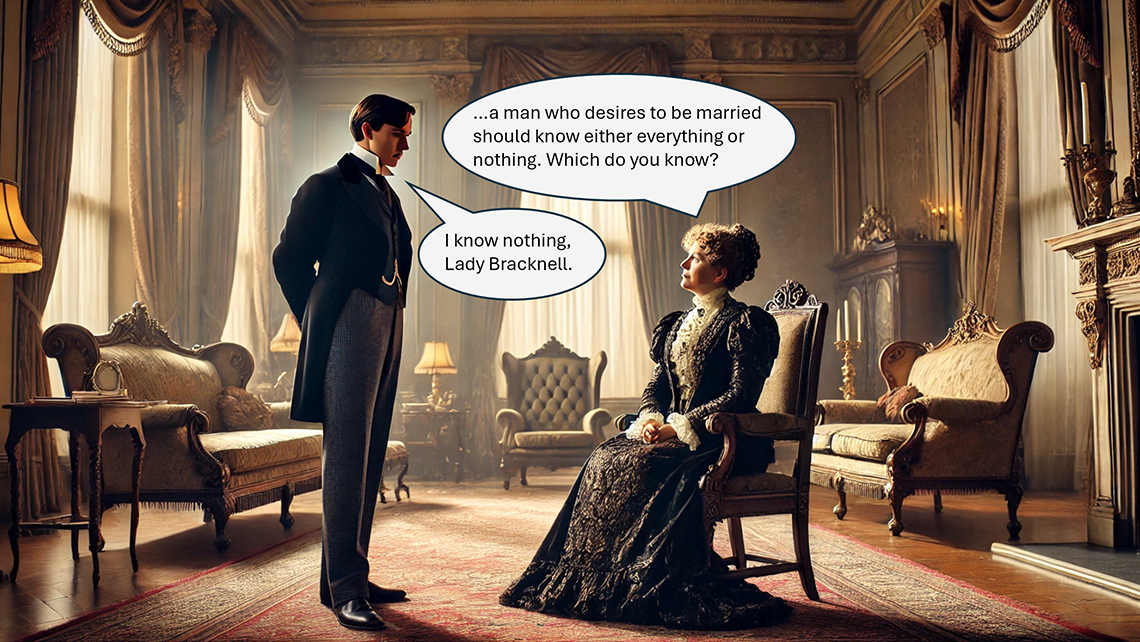
In the scene from Oscar Wilde’s classic 1895 play “The Importance of Being Earnest” pictured above, John (“Jack”/Earnest) Worthing takes knowledge humility to the extreme in his exchange with his future mother-in-law Lady Bracknell. While it’s clear that he at least knew the answer Lady Bracknell wanted, he could also have taken heart in that while he may not know much, the rest of humanity, even in his time, knew a lot. This was knowledge he not only could, but did, rely on. He tells Lady Bracknell that his income comes “from investments chiefly.” It’s a safe bet that he knew little or nothing about the financial system that allowed him to manage his wealth. How the banks, insurance companies, stock exchange, currency exchange systems and global markets came to be and how they functioned would have been a mystery to him. All he knew was that they facilitated his comfortable lifestyle. Over the course of the play, he rides in trains and carriages, which he knows how to get in and out of, but if tasked with explaining how they were designed and constructed would be stumped. At one point he receives a telegram[1] produced by emerging communication technologies he did not understand. Wealthier Londoners were beginning to install electric lighting in their flats, which required only the simple act of flipping a switch to miraculously convert a lump of coal, burned a mile away, into what felt like 24/7 sunshine. At one point he expresses concern about “a severe chill” being hereditary. Despite his ignorance of biology and medicine, if he ever needed surgery his chances of survival would have been greatly enhanced by Joseph Lister’s development of antiseptics and more sterile surgical techniques in the mid-19th century. I could go on and on, but you get the idea.
As often discussed in this blog and in my book, we humans often say we “know” something when we don’t. If beliefs are laid out on a spectrum with faith, a belief without evidence, on one end and knowledge, a belief with a lot of it, on the other, then much of what individual humans claim to “know” would be found far closer to the faith side. This is not to say that nobody knows anything and we’re all stumbling around blindly claiming knowledge that doesn’t exist. It means that much of what we know is held collectively rather than individually. When one believes in the power and process of reason, one can have a well-supported belief in knowledge that domain experts have developed via the culture of criticism.
I’m fond of using breakfast stories as a vehicle to illustrate how ideas work in practice. Let’s pay a little morning visit to a geneticist named Lisa to see what she can teach us about how knowledge is acquired and verified.
* * *
Lisa walks into the kitchen as her partner looks up from the table, “Coffee’s still fresh.”
She knows she looks like she could use a cup and smiles. “Did I keep you up last night?”
“No, no, it was fine. What were you reading?”
“Do you remember Raul from the department luncheon?”
Her partner nods.
“I was reading his paper about how diet affects your gut bacteria.”
“Is that why my croissant is getting such a judgmental stare?”
“I wasn’t judging, but it turns out a little more fiber might ward off schizophrenia.”
Her partner stops chewing and drops the croissant on the plate. “Seriously?”
Lisa laughs, “I’m joking, well, sort of, we know there’s a connection between gut bacteria and mental health by how it influences the nervous system. Raul’s team is sequencing the genome of gut microbes which he hopes might lead to the development of more effective neuropsychiatric drugs.”
“So, can I eat my croissant and wait for these drugs to come out?”
Lisa smiles over her cup, “yes.”
“You’re reviewing his paper?”
“I’m not part of the formal review process, he just wanted a little feedback before he submits it to the journals and knew I was interested in what his team is up to.”
“But isn’t this right up your street? I mean, you’re sequencing the genome of that giant Indonesian flower that smells like a dead body.”
“Rafflesia arnoldii.”
“Whatever. The point is you’re an expert in genome sequencing.”
“I might know a bit more than the average Josephine, but I would need a deeper background in human metabolism or microbiology before a journal would ask me to formally review Raul’s work.”
“Could Raul review yours?”
“Kind of the same deal. He could be a good source of feedback but probably not for formal peer review.”
“So how long will I have to wait for these drugs that will pull me back from my croissant-induced madness?”
“Oh, it’ll be a while yet. Assuming we don’t find out that Raul’s results or methods are flawed in some way and others are able to confirm his findings, it could be still years before we can begin developing and testing drugs. In the meantime, I’m sure Raul and his colleagues would agree that eating more plants, be they stinky or not, would be a good way to hedge your bets.”
“Humph” her partner says, wolfing the last bite of croissant.
This breakfast story illustrates a few important things about knowledge. That Lisa and Raul work in such distinct and narrow segments of one subset of biology shows how the immensity of human knowledge requires ever more specialization. It also demonstrates the importance of humility in knowledge acquisition. Lisa possesses a lot of general scientific knowledge, and deep knowledge about her domain, but is humble enough to recognize that the limits of her individual knowledge make her unsuitable to be part of the formal process of validating, attempting to falsify, Raul’s work. Lisa displays the patience and humility required to develop knowledge. She and her team, as well as Raul and his, have spent years working on their conjectures but must now wait, perhaps years, for their results to be confirmed by their colleagues and must accept the risk that they’ll be refuted, sending them back to the drawing board. Both feel strongly that they’re onto something but have to stand by while other domain experts try to prove them wrong.
If Lisa and Raul, who possess far more knowledge than the rest of us, don’t know enough to formally evaluate each other’s conjectures, what hope is there for us? Why should we abandon unsupported beliefs we’ve grown fond of when decades of study aren’t sufficient to determine what’s true and what not? The answer is that Lisa and Raul have a well-supported belief in the process of reason, in particular its culture of criticism, and we should too. The power of reason gives those without specific domain expertise confidence in the validity of collective knowledge outside their individual knowledge.
* * *
“If I left you alone in the woods with a hatchet, how long before you could send me an email?” – Joe Rogan
There is a narrative out there that modern humans are not as knowledgeable, or even as intelligent, as primitives. This narrative comes not only from former standup comedian/podcast moguls, but through flawed interpretations of work by serious academics like Jared Diamond and public intellectuals like Noah Yuval Harari. There’s a bit of the “noble savage” myth in the idea that hunter-gathers were happily hopping around communing with nature until the “Guns, Germs and Steel” messed it up for all those contented “Sapiens” While it’s certainly true that primitive humans needed to have direct access to a far higher share of total human collective knowledge than their modern counterparts, the amount of that collective knowledge was infinitesimal by comparison. Modern humans have a very thin layer of knowledge that runs across an immense breadth of collective knowledge, while primitives had to possess deep knowledge of the narrow range of what was known collectively. To put it another way, primitives had to rely more on their own process of reason while modern humans lean into its collective power. Where these noble savage romantics and Joe Rogan do have a point, however, is that the fact it’s easier for an individual to survive today without exercising critical thinking is a problem. A lack of critical thinking was often a ticket to an early grave for primitives, but is a trait found in many, many modern gainfully employed humans who procreate regularly[2].
We have gone from a world where one person could possess most of human knowledge to one where no one can know more than the tiniest fraction themselves. Collective knowledge is developed and verified by the process of reason. It requires patience and humility, as well as acceptance of a certain lack of certainty. It can be difficult to let the process play out but we can be certain that reason is the best method we humans have found to root out the truth. It is the engine of human progress. To believe in the power and process of reason is not an article of faith, it’s a belief supported by enough evidence to be considered knowledge. We know reason works; the evidence is all around us.
Journalist Jonathan Rauch in his book “The Constitution of Knowledge” describes knowledge as a shared resource, developed and verified collectively. Rauch’s framework posits that knowledge is not solely based on individual beliefs or authority but is collectively constructed through a process of inquiry, debate, and testing of ideas within a community of experts. We can be humble about the level of our own knowledge and still be comforted by the fact that humanity collectively knows quite a lot.
Humility, awe and gratitude. We can be humble about the level of our own knowledge and the limitations of our perceptions and intellect while still being awed by the power of reason and grateful for the blessings it has brought us.
[1] In the play the telegram is a forgery from Jack’s non-existent brother
[2] This is the premise for Mike Judge’s brilliant movie “Idiocracy”