

I love to start my day sitting on my front porch enjoying a warm bowl of knowledge and sunshine. Even if you’ve only browsed my blog posts or book, you’ve likely learned that the energy our bodies harvest from the food we eat comes from Aten’s life-giving rays, aka radiant solar energy, via photosynthesis. But how is there knowledge in the banana, berries, peaches, grapes, almonds, steel-cut oats and blended oat-milk in that bowl? Unless you’re hunting bugs, snakes and rats while foraging for edible plants as a contestant on the Discovery Channel’s reality show “Naked and Afraid” virtually everything you eat was created by human knowledge. We have learned how to grow more palatable foods, in ever increasing amounts, via genetic manipulation, changing the DNA of the plants and animal products we eat.
Mutant meals don’t just come from genetically modified organisms (GMOs). Our recently acquired ability to directly splice and dice genes in a lab is just the latest method we’ve come up with to alter the genetics of the plants and animals we put on our plates. The story of food transformation via genetic manipulation began thousands of years ago with the advent of agriculture. Mesopotamians started cultivating wheat and barley around 10,000 BCE and through trial and error began to alter the DNA of the plants they cultivated. These early farmers learned to select and propagate the best seeds, inadvertently kickstarting the process of artificial selection. Over generations, this led to the domestication of plants and animals, creating varieties optimized for human consumption through more advanced techniques like combing seeds and selectively breeding animals. For example, wild wheat grains were small and brittle, but through selective breeding, humans developed larger, more robust grains with higher yields.
While these ancient and modern methods all modify genetics, it is important to distinguish between GMOs and conventional breeding techniques. In traditional breeding, plants or animals with desirable traits are selected and crossbred over several generations to achieve the desired characteristics. This process relies on natural genetic variation and can take years, decades or even centuries to produce results. In contrast, GMOs involve the direct manipulation of an organism’s DNA using techniques such as gene splicing or CRISPR. While both methods alter genetic material, GMOs offer a level of precision and control that is unmatched by traditional breeding.
Regarding the relative health risks of GMOs vs conventional breeding, it’s essential to consider the scientific evidence and regulatory frameworks in place. Numerous studies have examined the safety of GMO foods and found them to be as safe as their conventionally bred counterparts. The World Health Organization, the National Academy of Sciences, and other reputable scientific organizations have concluded that GMO foods currently on the market are safe for human consumption.
It’s also worth noting that GMOs undergo rigorous testing and regulation before reaching the market, often more so than conventionally bred foods. Regulatory agencies such as the U.S. Food and Drug Administration (FDA), the European Food Safety Authority (EFSA), and others require comprehensive assessments of GMOs’ potential health and environmental impacts, including allergenicity, toxicity, and nutritional composition. These stringent regulatory measures aim to ensure the safety and integrity of GMO foods, providing consumers with confidence in their quality and reliability. In contrast, while conventional breeding methods have been used for centuries and are generally considered safe, they typically aren’t subject to the same level of regulatory scrutiny and testing. Nonetheless, both GMO and conventionally bred foods must adhere to established safety standards and undergo evaluation to protect public health and the environment.
That said, GMO technology is used in ways that are most definitely not good for humans and the biosphere. Farming has always faced the challenge of how to control pests. Conventional breeding led to varieties more resistant to pests and/or the use of pesticides. A big goal of GMO technology for companies who sell pesticides is to develop strands which can be drenched in that company’s products. This is exemplified by Monsanto’s development of GMO corn able to tolerate high levels of Roundup, whose main active ingredient, glyphosate, is associated with a number of health hazards.
The bottom line here is that GMO technology is essential to expanding our food production and continuing to reduce starvation and nutritional deficiencies worldwide and there is no reason to think that it creates foods that are any less healthy or pose any more health risks than conventionally raised foods. It’s also true however, that it’s used to facilitate excessive pesticide use which is harmful. Since it’s the pesticides that pose the risk, I would advocate removing the USDA’s restriction on GMO’s being certified organic. If you see that organic label, you know that no Roundup, or any other chemical pesticide, was used in its cultivation.
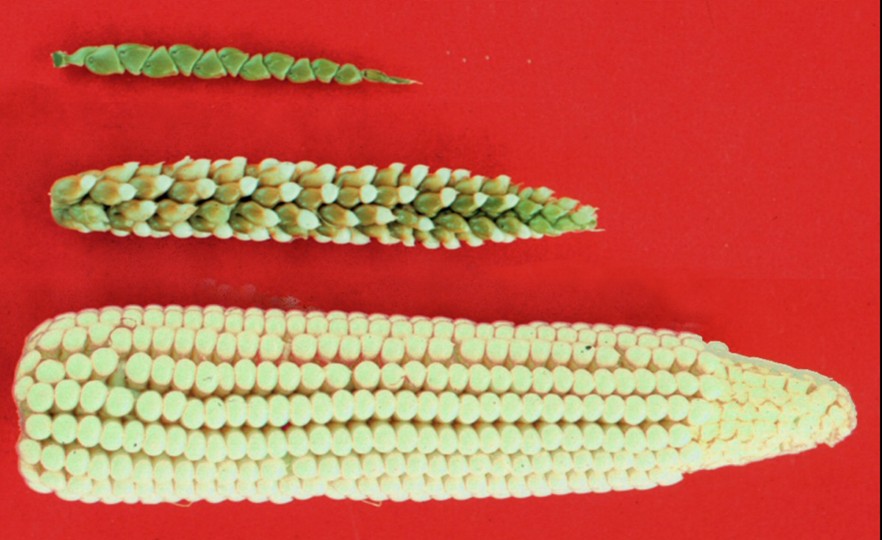
The impact of human knowledge on food is evident in everyday staples that have undergone significant transformations. Take corn, for example. Modern corn bears little resemblance to its wild ancestor, teosinte, which was selectively bred first into a maize-teosinte hybrid and then finally into what we recognize as corn (figure 1). Innovations in corn didn’t stop there! Monsanto’s Roundup-tolerant corn has produced over 30 million metric tons of high-fructose corn syrup (HFCS) right here in the US of A! Aggressive marketing, distribution and patent lawsuits have facilitated the expansion of HFCS use to the rest of the world so those nations can achieve the same levels of metabolic diseases like diabetes type 2 we enjoy here in America. Okay, so maybe not all the knowledge we eat is good for us.
* * *
While the historical curve of starvation and food insecurity shows steady improvement over the long haul, progress has spiked up dramatically in the last century. Starvation, which for most of our history was a common cause of death, has significantly declined on a per-capita basis, especially since the mid-20th century. This decline is largely due to advancements in agricultural productivity, often referred to as “The Green Revolution.” As recently as the 19th and early 20th centuries, famines and widespread hunger were common in many parts of the world, exacerbated by poor agricultural techniques and frequent wars. By the mid-20th century, many regions still suffered from chronic undernourishment, particularly in Asia and Sub-Saharan Africa.
However, since the 1970s, global hunger has steadily decreased. According to data from the Food and Agriculture Organization (FAO), the percentage of undernourished people globally fell from around 35% in the 1970s to less than 10% today. This decline was driven by improvements in food production, international aid, and better economic conditions. The Green Revolution, which introduced high-yield crop varieties and modern farming techniques, played a key role in increasing food availability. The soldiers in this revolution were not environmentalists, but scientists, engineers and logisticians.
American agronomist Norman Borlaug, who is known as “The Father of the Green Revolution” led initiatives worldwide that contributed to the extensive increases in agricultural production. The strain of “dwarf wheat” he developed is credited with saving over 1 billion people from starvation. Borlaug is one of only seven people in history to be awarded the Nobel Prize, the Presidential Medal of Freedom and the Congressional Gold Medal. If I ever come up with a New Atenism prize for reason, knowledge and human progress, Norman Borlaug would be on the short-list to get one.
While knowledge and reason have made tremendous progress, food insecurity remains an issue for around 9% of the global population. Far fewer people are starving now, on a per-capita basis, than at any other time in recorded history. However, challenges remain in eradicating hunger completely, especially in the world’s poorest regions. As we increase our ability to provide sufficient calories we have been able to devote more attention to nutritional deficiencies.
Golden rice, a beta-carotene infused grain developed with GMO technologies, targets vitamin A deficiency. Research began in the 1980s, the first trials began in 2004 and the first large scale human trials in 2015. The broad scientific consensus is that golden rice is not only safe, but can have a profound impact on vision loss in the developing world. Despite this, many environmental and anti-globalization groups have worked hard to get golden rice banned. You would be hard-pressed to find anyone who objects to dwarf wheat, so what’s up with all the golden rice haters?
The short answer is that dwarf wheat was developed through traditional breeding, which humans have used for thousands of years and laypeople, in general, don’t consider to be “unnatural” or “risky.” Golden rice, on the other hand, involves direct genetic modification in a laboratory. Most people don’t understand how this really works and it scares them because it sounds sort of sci-fi and dystopian. They imagine that these “frankinfoods” once created will continue to mutate causing environmental havoc or even create new organisms that bring on a zombie apocalypse. The term “genetically modified” triggers distrust, even when the modification is beneficial.
Dwarf wheat was largely seen as a humanitarian breakthrough, spearheaded by Norman Borlaug and the public sector. Golden rice, despite being a non-profit initiative, has been unfairly lumped in with corporate GMOs, leading to misguided fears of corporate control over agriculture.
By the time Golden rice emerged, there was already a strong anti-GMO movement, largely fueled by environmental groups like Greenpeace. These movements are based on superstition rather than science. The media tends to highlight fear and controversy, as it produces more interest and clicks, and this reinforced public skepticism about GMOs, despite science overwhelmingly supporting their safety.
Why do people love dwarf wheat and hate golden rice? They fear GMO technology because they don’t understand it and refuse to accept what collective reason has revealed about the actual risks. They stick with the story that justifies their intuition. If one is humble about the level of one’s own knowledge, awed by the breadth, depth and power of collective human knowledge and grateful for the blessing of progress it bestows upon us, one should embrace golden rice. Either that or it’s time to put tape over the “science is real” line on that sign in your front yard.
In the next blog post we’ll get more into how the knowledge we eat can help us thrive or lead to an early grave.