

Stupid is having a moment. The graphic below shows a radical increase in mentions of “stupid” beginning in 2004 after remaining more or less the same over the course of the 20th century.
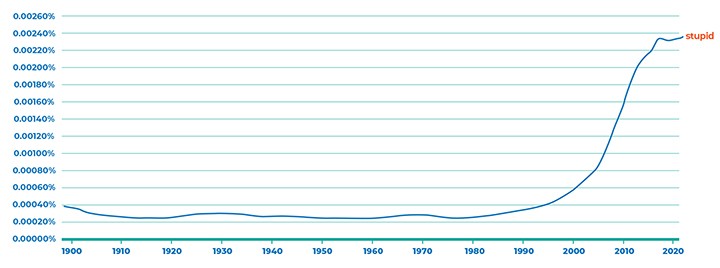
Google Ngram chart of of “stupid ” in printed material.
There is a curious correlation between mentions of “stupid” and the explosive growth of social media over the same period.
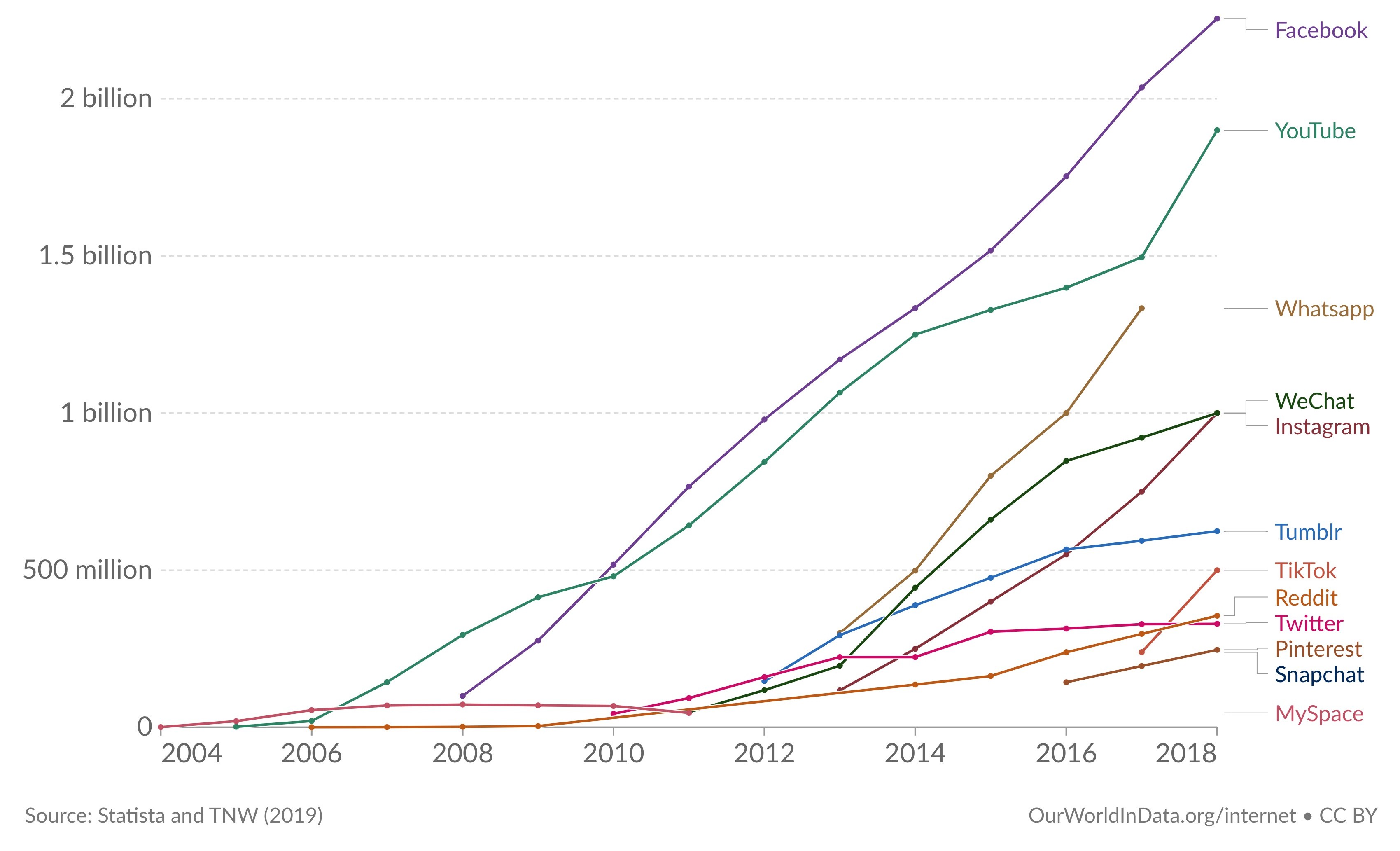
Social Media use between 2004 and 2018 – Our World in Data
While this doesn’t prove causation, it seems reasonable to assume that the symbiotic relationship of social media and polarization/tribalism were a primary driver of stupid’s rise. It’s also worth noting that the Google Ngram stats are for printed materials only. Do you think “stupid” gets used more often or less often online than in print?
In the minds of most people there are two kinds of stupid:
- Stupid actions where stupidity is a temporary state. Even the most intelligent among us will sometimes do stupid things.
- Stupid people. Those with low IQs and/or a lack of critical thinking skills.
“Well, that was stupid of me” (#1) can be a constructive inner dialog. “You are really stupid” (#2) is probably not going to get someone to question their beliefs or behavior. It seems unlikely that the 2004 rise of stupid is dominated by people evaluating their own actions in order to better understand their own minds and become better people. But if calling someone, or a group of someones, stupid is unlikely to move anyone towards a new way of thinking, why are so many people doing it?
Calling others stupid is a way of telling yourself “I’m smart,” or at least smarter than they are. In addition to this personal satisfaction there are social rewards. Declaring that someone outside of your tribe is stupid is a quick way to get approval from inside yours. Regular readers of this blog or my book will be familiar with Jonathan Haidt’s analogy of an emotional elephant and a rational rider. The idea is that instinct and emotion (the elephant) drive us more than reason (the rider). The reasoning rider is far more likely to rationalize what the elephant wants than evaluate it. This rider submission trait does not seem to be related to an inability to think critically. In fact, there is evidence which suggests that individuals with greater cognitive reflective capabilities are more likely to use those skills to support ideologically motivated reasoning. In other words, a deeper understanding of critical thinking is often employed to adopt the mantle of a critical thinker while doing precisely the opposite.
All this has created an environment where people use their reasoning and rhetorical gifts to seek emotional, and sometimes financial, rewards from massive online communities of the like-minded. For these folks, just saying “Man, those dudes are so stupid” won’t do. A more reasonable-sounding way of calling people stupid must be found. A popular reference for their arguments is the German Lutheran pastor and Nazi dissident, Dietrich Bonhoeffer. Bonhoeffer’s letters and papers, written in a Nazi jail cell, made him the great philosopher of stupid. Bonhoeffer saw stupidity as more dangerous than evil or malice.
“Stupidity is a more dangerous enemy of the good than malice. One may protest against evil; it can be exposed and, if need be, prevented by use of force. Evil always carries within itself the germ of its own subversion in that it leaves behind in human beings at least a sense of unease. Against stupidity we are defenseless…In all this the stupid person, in contrast to the malicious one, is utterly self-satisfied and, being easily irritated, becomes dangerous by going on the attack.” – Dietrich Bonhoeffer
Bonhoeffer’s writings are often cited by both sides of a debate as pseudo-intellectual support for calling people who disagree with them stupid. For example, here in the U.S., the anti-MAGA crowd is fond of citing Bonhoeffer to explain why it’s useless to try and reason with those stupid Trump supporters. Conservative evangelicals, on the other hand, describe Bonhoeffer as a Christian crusader who battled the Nazis, mirroring their noble struggle with stupid, Godless lefties.
While Bonhoeffer did have a lot to say about stupid people, he also said this.
“The impression one gains is not so much that stupidity is a congenital defect, but that, under certain circumstances, people are made stupid or that they allow this to happen to them…If we want to know how to get the better of stupidity, we must seek to understand its nature.” – Dietrich Bonhoeffer
That sounds a lot more like stupid #1, a temporary state which can afflict people regardless of education, intelligence or belief in critical thinking. If otherwise intelligent people can “under certain circumstances” be led to do stupid things, and can often do a better job of rationalizing those actions, shouldn’t our focus be on those circumstances? What were the “certain circumstances” that led the German people to follow Hitler and resulted in Bonhoeffer being imprisoned?
Germany was humiliated at the end of World War I. More than 10% of the population was either killed or wounded. With over two million soldiers killed, another four million wounded and at least seven hundred thousand civilian deaths from blockades, famine and disease, few households avoided tragedy. As bad as this was, the treaty of Versailles, which formally ended the war, made things even worse. Unlike the post-WWII Marshal Plan, which focused on rebuilding Germany, the treaty of Versailles was designed to extract additional punishment from the German people. This led to the hyperinflation of the early 1920s, which devastated the savings of millions, caused mass unemployment and desperation. It is difficult to describe just how bad life was for Germans during this time. A loaf of bread that cost 250 marks in January 1923 cost 200 billion marks by November. Bank notes literally became not worth the paper they were printed on, so people burned them to keep warm. Unemployment skyrocketed and the government had no money to pay benefits. Starvation and suicide became common.
Along came Adolf Hitler with his story of economic salvation, national pride, and scapegoating. He promised to fix their problems and told them who was to blame for them. He claimed Germany didn’t lose WWI, but were betrayed by Jews, communists, and weak politicians. He promised to restore Germany’s greatness by crushing its enemies. He promised law, order, and discipline in contrast to the chaos of Weimar Germany. Just imagine how good that would sound to you if you’re huddled around a bank note fire watching your family slowly starve to death. It would take one hell of an elephant rider to be able to pull away from that. Hitler is an extreme example of what I call an Elephant Herder. He rose to power with a story the German people wanted so badly to be true, they would reject any information or evidence which questioned it.
It is a mistake to interpret Bonhoeffer as claiming that stupid people (#1) are more dangerous than evil ones. Evil fosters and manipulates stupid #2 in otherwise intelligent people. Hitler, the very personification of evil, was dangerous because of his ability to manipulate emotions to get otherwise smart people to do something stupid. By calling Hitler’s followers stupid, especially given his relatively privileged life, Bonhoeffer was more likely to further entrench their belief in Hitler than get them to question it. His life was quite different from that of the average German during the 1920s and 1930s. He was raised in relative affluence and his well-connected family remained relatively untouched. While millions of Germans struggled to find work during the Great Depression, Bonhoeffer spent time studying theology in Berlin, and then briefly at Union Theological Seminary in New York. This gave him exposure to progressive Christian thought and racial injustice in America, but it also meant he wasn’t directly suffering like the German masses.
When Hitler rose to power in 1933, Bonhoeffer was already an ordained pastor and academic, moving in elite circles that largely rejected the Nazi movement. From his lofty perch, Bonhoeffer saw the danger of Hitler’s rise and became a vocal critic. While this was incredibly courageous and noble, his background and education made him more of an observer of German suffering than a direct participant in it. This may have led to his less-than-compassionate view of why people fell for Hitler’s rhetoric.
Bonhoeffer’s opposition to Hitler, which may well have included being involved in a plot to assassinate him, was morally courageous, and it ultimately cost him his life, but perhaps he wasn’t able to fully understand the emotions which led so many Germans to be swept up in Hitler’s movement. It’s possible his privileged upbringing insulated him from the worst of Germany’s desperation and made it harder for him to empathize with those who followed Hitler out of emotional need rather than pure ideology. The understanding of how people can “be made stupid” under certain conditions, may have eluded him as he sat in a prison cell. Perhaps emotion prevented him from being able to see that the reasoning of the German people wasn’t absent, it had just been overridden by emotion. If that’s the case, it is understandable that he would lean more into stupid #2 and dismiss Hitler’s followers as fools rather than attempti to understand the “circumstances” that led them astray.
This is the great irony of stupid. Bonhoeffer’s warning about stupidity often applies to so-called enlightened critics as much as it does to the people they call stupid. Their ability to employ reason or feel empathy gets overridden by emotion; frustration about what they perceive as mindless acts, their own tribal loyalties, and that warm, fuzzy feeling of superiority. Instead of engaging with people who hold contrary beliefs to try and understand where they’re coming from, they react emotionally, dismissing them as stupid. They are engaging in the same emotion-driven behavior they identify as stupid in others.
The German people were desperate, humiliated, and grasping for hope. Hitler understood this and crafted a compelling narrative that spoke to these emotional wants. To call them stupid and expect them to question their choices was never going to stand up to Hitler’s emotionally charged narrative. Hitler was as dark and evil as it gets, but refusing to acknowledge that he was a master Elephant Herder—just because it feels wrong to say anything remotely positive about him—ignores history, and we all know where that leads.
If we overlay our improved understanding of how emotion leads us more than reason, it yields a universal insight. What we think of as stupid acts, done by stupid people, are more often the result of this fundamental human trait. The less prosperous, the more desperate someone is, the more susceptible they are to stories that play on the emotions that desperation causes. While Germans in the 20’s suffered tangible, material desperation, materially prosperous contemporary individuals are often desperate enough for social acceptance and that feeling of superiority, they leave reason behind and say and do, well, stupid stuff. This is the connection between the rise of stupid and the rise of social media.
The problem with calling people stupid is that it makes you a shitty Elephant Herder. A real Elephant Herder rises above their own instincts, understands the emotions of others, and leads them to a better path. If we’re interested in uniting humans in a common goal of progress and prosperity, then we need to bend the curve of that stupid mentions graph I started this post with back down. Calling someone stupid is the essence of illiberalism. It not only prevents the free exchange of ideas but, crucially, allows you to avoid any effort to try and understand those ideas and what circumstances may have caused someone to arrive at them.
It shouldn’t require any deep thinking or self-reflection to realize that the desire to call someone stupid is not an honest and well-meaning attempt to get them to reconsider a belief or change a behavior. Critical thinking is most challenging when turned inward. We all find it easier to question the beliefs of others than to question our own. To truly be a critical thinker you must constantly question your beliefs. Why do I think that? What biases might I have that drive that belief? Am I making a valid argument or just summarily rejecting anything that counters an intuition I’ve attached myself to? It is often difficult to answer these questions inside your own head so seek input from others. Try to develop a culture of criticism inside your own social group rather than just getting together to rail about all those stupid people. Building your own internal culture of criticism and expanding it to your social group will be the subject of my next (stupid) blog post.