How Reggie White's Reason Rush Got Blocked by Dogma
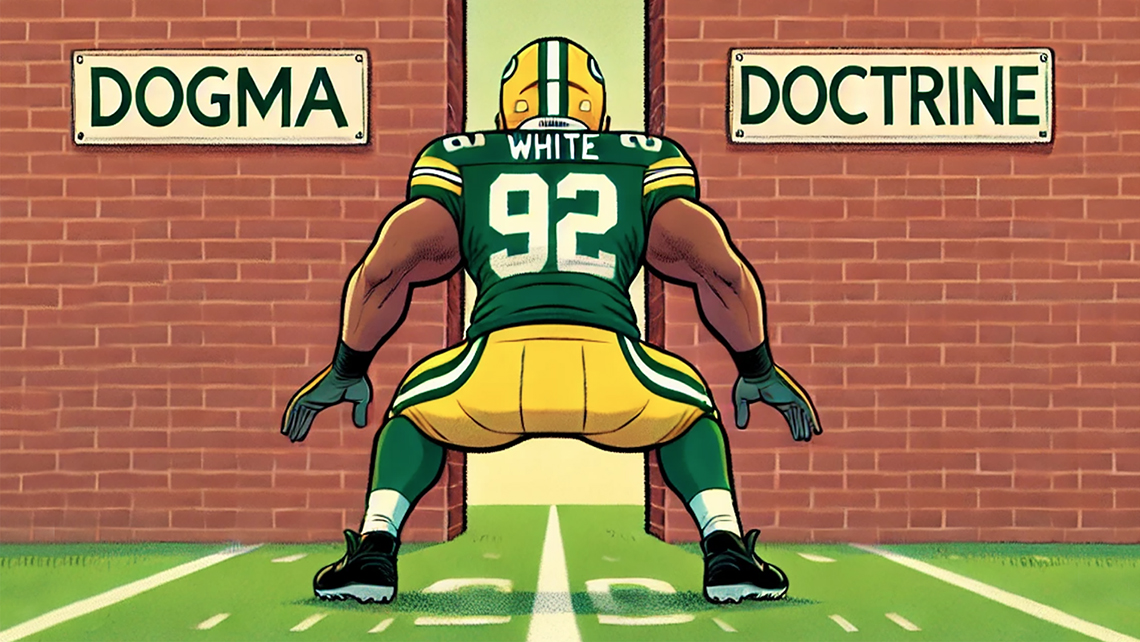
Reggie White is best known for playing football, but his story also has much to tell us about religion and reason. A member of the NFL’s Hall of Fame, he is widely considered to be the best defensive lineman in the game’s history. Reggie’s signature “hump move” was a sort of Ju Jitsu on the linemen whose job it was to block him from getting to the quarterback. Reggie would fake a move to the outside to get the blocker to lean that way and then shove him that way, using his momentum against him. This would open a lane to the inside and to the, now defenseless, quarterback. It sounds simple, but even though they knew it was coming, few offensive linemen found a reliable way to stop it. Fascinating stuff if you’re a football fan, but what could it possibly have to do with reason and religion?
In addition to playing football, Reggie was an ordained minister who frequently preached in his church and proselytized pretty much everywhere else. Reggie fervently believed that the Bible was the true word of God, the divine instruction manual for humans. Near the end of his 15-year football career, and close to his untimely death from heart disease at 43, he began to question things he’d always believed. He began to wonder if his passive acceptance of what religious authorities told him God’s word was had in fact been blocking him from the truth. He decided to shove authority aside and rush to the truth himself. The story of how Reggie defied authority and doctrine to pursue the truth through direct examination of evidence provides a great illustration of the difference between faith and reason and between belief and knowledge. The critical thinking he employed to evolve his religious beliefs also demonstrated how reason and religion can work together, up to a point. While his questioning received dogma and doctrine is laudable, there were dogmatic beliefs he never even thought of trying to reason his way around.
Reggie grew up in a deeply Christian household, attending church every Sunday and regularly participating in Bible study classes. By the time he was a freshman in high school, his football talent was already attracting attention. He was invited to preach at his church, a role that ultimately led to his ordination as a Baptist minister. Throughout his career “The Minister of Defense” had one foot on the gridiron and the other at the pulpit. He was known for openly displaying and discussing his faith on the field and in interviews. Some of his evangelizing, like organizing prayers on the field, including the opposing team, were praised by believers and even some skeptics. Some of his comments off the field, however, caused controversary. In in a speech to the Wisconsin state legislature in 1998 and a subsequent interview with ABC’s 20/20 he described homosexuality as both a choice and an abomination citing Biblical sources. His comments were widely criticized and cost him millions of dollars in lost contracts and sponsorships.
Near the end of his football career, he was introduced to Torah-observant Messianic theology, which involved reading the Torah in its original, ancient Hebrew. The Torah, commonly referred to as the Pentateuch by Christians, consists of the first five books of the Hebrew Bible (Genesis, Exodus, Leviticus, Numbers, and Deuteronomy). It is considered the most sacred text in Judaism and contains foundational narratives, laws, and teachings. The Torah is also the basis for the first five books of the Old Testament in the Christian Bible, though some textual differences exist between Jewish and Christian versions. Reggie traveled to Jerusalem and personally studied the Aleppo Codex, one of the oldest and most complete surviving manuscripts of the Hebrew Bible.
He began to realize that everything he believed about the Old Testament was what he was told to believe by the religious authorities in his life. He would later say “I’ve been a preacher for 21 years, preaching what somebody wrote or what I heard somebody else say. I was not a student of Scripture.” He decided that if he was going to claim to know the word of God, he needed to read it for himself so at the age of 40 he took on the monumental task of learning Hebrew. He studied with scholars in Israel, poured over the original text of the Torah, which he believed to be “what God actually said.”
For someone so steeped in, and whose social position was so dependent upon, what religious authority had told him to believe, being able to step back and question those beliefs so fundamentally was remarkable. This period of his life was Reggie’s personal age of reason, when he rejected authority and decided to pursue knowledge by examining evidence directly. His study of the Torah led him to reject things he’d believed his entire life. Most strikingly, he rejected the mainstream Christian concept of the Trinity and embraced monotheism. He also developed a deep respect for other Jewish traditions and began observing Jewish holidays and rituals. This led many Christians to think he’d abandoned their team to sign up with Judaism as a free agent. This was not the case, he continued to identify as a Christian, and to believe that Jesus was the Messiah, but by rejecting elements of the Christian doctrine of his youth many old friends now considered him to be an “other.”
Reggie began to say things that sounded more like a humanist than a true believer. In an interview with ESPN for a “30 for 30” documentary about him he said, “And sometimes, when I look back at my life, there’s a lot things I said God said to me, that I realize God didn’t say nothing, it was what Reggie wanted to do.” Later in the same interview he sounded even more like a skeptic. “I realized that over the centuries, the church leaders have used fear tactics to try and keep people under control.” He even said he felt he’d be “prostituted” by religious authorities who exploited his football fame. “When I look on it now, maybe I was wrong.”
He learned that there is no concept of hell or eternal torture in either the Old or New Testament. He learned that Jesus was not born on December 25th so his family stopped celebrating Christmas. He questioned why Jesus is depicted as a long haired, blue-eyed, fair-skinned European when he came from the Middle East. He learned that eating pork is an abomination, though he’d eaten pork his entire life. All this led to a more profound realization that it was not his place to condemn people for sinful behavior, that only God can pass judgement. While it could be argued that he was talking about, or at least including, LGBTQ+ people in this re-thinking, he never retracted or modified any of his homophobic statements.
Having shoved religious authority out of way, he now believed he had a clear path to the truth. Armed with his knowledge of Hebrew, he longer had to take someone else’s word, he believed he could read God’s words for himself. This questioning, this critical thinking, had expanded his knowledge and opened his mind but there was one question he apparently never thought to ask: were these really the words of God?
This is the dogmatic wall Reggie never even tried to get around. He never questioned whether God actually spoke to Moses from a burning bush[1] or Mount Sinai[2], never wondered if God actually spoke to Samuel in the tabernacle[3] or Elijah on Mount Horeb[4]? Were the angelic revelations, dreams, visions and inspirations of Isaiah, Jeremiah, Ezekiel, Joseph and Daniel true divine communications, or were they just dreams or hallucinations? Beyond, or really beneath, all of that was the assumption the words he was reading were written by Moses who was a historical figure rather than a mythological one. While there is still a lot of scholarly debate about how the Torah came to be, there is broad consensus that it is a collection of writings from different sources compiled from multiple sources over several centuries.
Reggie was reading Hebrew but many of the characters found in the Torah would likely have spoken some form of ancient Semitic language which, while part of the evolution of Hebrew, may well have been quite different. What language did God speak to these characters? How and when were those words captured and translated into the Hebrew Reggie had painstakingly learned? How accurate were the oral transmissions, the storytelling across generations which likely pre-dated the writing of The Torah by centuries? All of these questions, along with the ultimate question of whether any of the revelations described even happened, were questions Reggie never asked. He accepted this dogma as the truth, never applying the critical thinking he employed when questioning the doctrine of the church he grew up in. While he’d shoved aside the religious authorities of his youth, he still accepted, entirely on faith, that the Hebrew words he was reading were an accurate accounting of divine revelations that actually took place.
He was still preaching what somebody wrote or what he heard somebody else say. That “somebody else” was no longer the religious authorities who “prostituted” him, it was the humans who claimed a divine revelation took place and the long chain of oral transmissions and written translations between that claimed revelation and the creation of the text he was able to read. He acknowledged that religious leaders “used fear tactics to control people” but never questioned whether that was going on during the hundreds of years between the claimed revelations in the Torah and the creation of the text he was reading.
Reggie’s rush can be compared to that of a 13th century Dominican friar. Thomas Aquinas (1225–1274) was a philosopher and theologian whose synthesis of Aristotelian philosophy and Christian theology greatly influenced medieval Christian thought. Aquinas gave reason a central role in theology: God’s existence could be demonstrated, natural law could be discerned, and moral truths could be argued rationally. For centuries, Aquinas shaped the way Christianity understood the relationship between faith and reason. Aquinas didn’t deny reason; far from it — he gives it a heroic role in proving God’s existence, discerning natural law, and articulating moral truths. But like Reggie, he accepted that revelation as told in the Bible was a truth to be accepted rather than an idea to be scrutinized by reason.
Scripture, for Aquinas and Reggie, isn’t a poetic exercise: it’s real history wherein God entered the world, spoke through prophets, and ultimately became Incarnation. Using reason to serve and defend revelation is fine but question revelation and you’ll receive a dogmatic penalty flag. The belief that the God of the Torah not only exists but communicated with humans and that the text faithfully and accurately captured those communications is dogmatic, not to be questioned. Reggie White’s age of reason shows us reason can and should be employed in theology but how dogma is ultimately the blocker to the truth that can’t be reasoned with.
[1] Exodus 3
[2] Exodus 20
[3] 1 Samuel 3
[4] 1 Kings 19