Knowledge is Yummy Part II
Too Much Knowledge Causes Diabetes
In my last blog post, we discussed how humanity’s ability to manipulate the genetics of plants and animals over the last 10,000 years has dramatically reduced starvation and under-nutrition. In this post we’ll look at some of the negative effects which have resulted from our incredible progress in creating vast amounts of desirable food that are readily available. The focus of knowledge and progress in our food system has been economic. Profits derived from our ever-increasing ability to deliver calories created both larger food corporations and larger, less healthy, food consumers. Is it possible to harness the incredible knowledge of our modern food supply chain without requiring nutrition to take a back seat? Spoiler alert: the answer is yes.
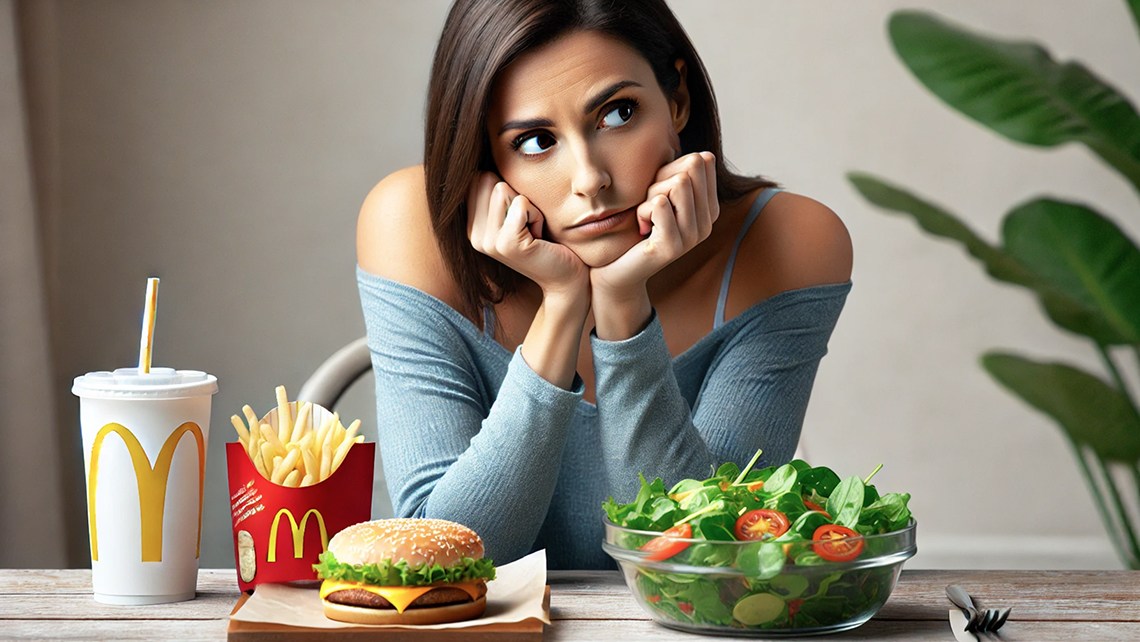
There may be no better example of a “first world problem” than having access to too many calories rather than too few. The knowledge that made it so easy for us to acquire mouth-watering food at virtually any moment, however, has a dark side: the inverse relationship between the effort required per calorie for a food choice and how healthy a choice it is. Let’s compare a drive through fast-food hamburger and an organic salad you make yourself. The cost of the ingredients for the salad and the cheeseburger are both around $3.00[1] but while the salad requires a trip to the store, preparation and cleanup, the cheeseburger can be obtained while sitting in your car listening to Joe Rogan’s podcast. That cheeseburger costs about a penny per calorie and the salad roughly two pennies—and that’s only if you overdress it[2]. While the salad is clearly the healthier choice, it requires more effort and costs twice as much per calorie. Few perform this sort of cost/effort analysis when deciding between a cheeseburger and a salad. It’s the cheeseburger’s mouth-watering flavor and deep, if somewhat guilt-tinged, satisfaction it delivers that tips the scale.
The irresistible flavor of a cheeseburger is a product of human knowledge. All of the basic components, patty, cheese, bun veggies etc., were all developed through centuries of plant hybridization and selected animal breeding. If you set out to create a cheeseburger with only ingredients in their natural state, i.e., not manipulated by humans, not only would you not find a pickle tree or a bun bush, the closest you could get to a modern steer, would be a bison.
The plant hybridization and selective animal breeding which occurred over the centuries to make foods more palatable and plentiful was supercharged in the 20th century with advancements in food processing. In parallel, the emerging science of human cravings led to the design of foods which enflame those cravings more and more effectively. Our bodies were designed for a world where low-caloric density plants required far less effort to obtain than high-caloric density animal flesh and we now live in one where not only the savory animals, but an endless variety of irresistible calorically dense treats are pretty much always at our fingertips. Metabolic diseases like type 2 diabetes, gout and certain types of cancer, which used to affect only the rich, now disproportionately affect the poor.
While knowledge has saved billions of lives, it is also killing us because it made things like cheeseburgers taste so damn good and so easy to get. What good is all that knowledge if it’s making us fat and sick? Would it be better to stick with nature and have a reason and knowledge free salad?
Whether it’s a simple salad made from locally grown organic ingredients or a fast-food cheeseburger, these meals reflect a staggering amount of human ingenuity, innovation, and knowledge. Both the salad and the cheeseburger might seem straightforward, but each requires centuries of advancement in agriculture, food science, and logistics to make it to your plate. This blog post will explore the hidden complexity behind these seemingly simple meals, focusing on the amount of knowledge embedded in their production—and the consequences of that knowledge for human health and the environment.
The McDonald’s cheeseburger is an industrial food product, but it is also deeply rooted in the ancient history of human food production. The ingredients—beef, cheese, bread, and vegetables—all owe their existence to centuries of agricultural progress. Cattle domestication, which dates back over 10,000 years, allowed humans to rear livestock for meat and milk, leading to the dairy products we use today like cheese. Similarly, the cultivation of wheat used in those buns began in the Fertile Crescent about 12,000 years ago, and tomatoes, used in ketchup, were first domesticated in South America around 500BC.
These basic ingredients have evolved significantly through selective breeding, hybridization, and the development of modern agricultural techniques. Wheat strains have been bred for higher yields, resistance to pests, and gluten content that makes for the soft, pliable buns McDonald’s uses in its burgers. The cattle that produce the beef and dairy have been bred for size, productivity, and efficiency, ensuring that McDonald’s can produce its burgers in the billions each year.
The real marvel, however, lies not in the history of agriculture but in the modern food system that makes a McDonald’s cheeseburger possible. McDonald’s epitomizes the efficiency of industrial food production. Its supply chain is a finely tuned machine, ensuring that ingredients are harvested, processed, and delivered to locations worldwide at the lowest possible cost. Beef patties are processed at enormous factories, buns are baked in industrial-scale bakeries, and every step of the process is optimized for speed, efficiency, and cost reduction.
For just a few dollars, you can buy a McDonald’s cheeseburger that provides a substantial amount of calories for the price. Compare that to the effort it would take hunter-gatherers to acquire similar calories—tracking game, preparing meat, and foraging for plant-based foods. The modern cheeseburger represents an incredible achievement: the ability to feed billions of people cheaply and efficiently.
But efficiency comes at a price. McDonald’s cheeseburgers, like many other fast foods, are high in calories, fat, and sodium, while offering little in the way of essential nutrients. The rise of processed and ultra-processed foods—foods that have been significantly altered from their natural state through industrial processes—has contributed to a global health crisis. Obesity, diabetes, and other metabolic diseases have spiked alongside the increased consumption of ultra-processed foods, which tend to be more affordable and accessible than healthier alternatives. Ultra-processed foods are often engineered to be hyper-palatable, meaning they are designed to be irresistible, leading to overconsumption. The convenience and affordability of these foods, coupled with their long shelf life, have made them a staple of the modern diet—but at a tremendous cost to public health.
That salad seems like the ultimate “all-natural” meal. Its fresh vegetables and organic label promise it was grown without synthetic pesticides or fertilizers. However, even that simple salad represents centuries of human knowledge and intervention. The lettuce, tomatoes, and cucumbers in that salad have also been selectively bred for generations to enhance their flavor, size, yield, and resistance to disease. The wild ancestors of these crops would be almost unrecognizable today. Hybridization—crossbreeding different varieties of plants to create new strains with desirable traits—has played a huge role in modern agriculture. This knowledge has allowed farmers to produce more food on less land while still maintaining the organic label.
The vast majority of organic produce in the United States is produced by large, corporate farms. About 88% of organic sales take place through conventional supermarkets and natural food chains, which rely on large suppliers to meet demand. This means that much of the organic produce sold in the U.S. comes from large-scale operations that, while organic, often resemble large, conventional farm systems in their cultivation and distribution. These large organic farms use mechanized equipment, monocropping, and high-volume production to supply organic fruits and vegetables to supermarkets like Whole Foods and Kroger. Although the crops are grown without synthetic chemicals, these farms operate on a scale that raises questions about sustainability. In fact, research shows that larger organic farms tend to use fewer agroecological practices, such as crop diversity and natural pest control, compared to smaller farms.
Even getting organic produce to your local market involves a surprising amount of knowledge and infrastructure. Organic vegetables must be harvested, stored, and transported in ways that preserve their freshness without the use of preservatives or artificial ripening agents. In some cases, organic produce is shipped hundreds or even thousands of miles to reach consumers, raising questions about its environmental impact. The logistics behind keeping these products fresh and available year-round requires a deep understanding of food science, packaging, and distribution networks.
My purpose here is not to equate a salad with a McDonald’s cheeseburger, at least not nutritionally, but rather to point out that there are elements of our food progress which have been incredibly helpful to humans but have also produced unintended consequences. The spirit of reason is embracing the helpful and rejecting the harmful which, in this context, means embracing our ability to provide food on a massive scale and our ability to reduce the effort required by everyone to obtain food while rejecting foods that are killing us and our planet. This may sound like a false choice, or an impossible dream, but reason is already hard at work on solving this puzzle.
Lab-grown meat, technology that still in its infancy, offers a way to produce meat products without the environmental and ethical concerns associated with traditional animal farming. It has the potential to dramatically reduce land use, water consumption, and greenhouse gas emissions.
Companies like Beyond Meat and Impossible Foods are developing plant-based products that closely mimic the taste and texture of traditional meat. These alternatives are already more sustainable and often have fewer calories and saturated fats than the meat we currently consume.
Local hydroponic farms, which grow food without soil, and vertical farms, which optimize space and resources, are helping cities grow fresh, nutritious vegetables in controlled environments. This can significantly reduce transportation costs and environmental impact while maintaining a consistent supply of fresh, healthy produce. Growing these facilities to a scale where they can provide truly local sources that don’t require long-range transportation will dramatically increase availability of fresh, healthy foods while reducing greenhouse gas emissions.
Researchers are working on biofortification, the process of breeding crops to increase their nutritional value. This has the potential to make mass-produced foods as nutritionally dense as salads. Another innovative approach to crafting healthy, sustainable food ingredients that are scalable for mass production is precision fermentation which creates dairy alternatives and nutrient-dense ingredients.
These technologies show promise for creating nutritious, sustainable, and delicious food options that could bridge the gap between the ease and appeal of cheeseburgers and the nutritional benefits of salads. We need to direct the power and process of reason on developing a food system that makes healthy, sustainable foods as easy to obtain as that cheeseburger. In the meantime, if you have the means, your best bet for your own health and our planet’s is that salad, especially if the ingredients are grown locally.
[1] A McDonald’s cheeseburger currently costs an average of $2.79 in the US and a single serving of organic greens
cucumbers, tomatoes and carrots along with a bit of olive oil and vinegar should cost you close to $3 depending on where you shop
[2] My wife claims I habitually under-dress salad