
The Four Flavors of Reason
In the 18th century the English philosopher, David Hume said “reason is and ought only to be the slave of the passions.” Five years after Hume’s death in 1776, the German philosopher Immanuel Kant, published the “Critique of Pure Reason” which included his view that universal moral truths, what he called “categorical imperatives,” could be deduced by any rational person, using, well, “pure reason.” This frames a debate about the value of reason that continues to this day. What has reason revealed about the value of reason? Modern psychologists and neuroscientists have shown how the emotional center of our brains, the limbic system, controls the reasoning neocortex far more often than the reverse, which would seem to support Hume more than Kant. Daniel Kahneman, known as the “father of behavioral economics,” in his seminal 2011 book “Thinking, Fast and Slow,” identifies two thought systems: our fast, intuitive, and emotional system 1 and our more deliberate and analytical system 2. He makes it very clear which of these systems he believes to be dominant.
“Most of the time, we are driven by System 1, and while System 2 can intervene and correct, it does so only under specific circumstances.” – From “Thinking, Fast and Slow” Daniel Kahneman
If reason can only rarely rise up from its subservient position as a slave to the passions, wouldn’t one have to be an idiot to form a religion based on it? While my personal system 1 quickly and summarily rejects the idiot label, my system 2’s low, but considered, opinion of the level of my own knowledge embraces it. Despite my well-reasoned ignorance, I will make the argument that the power of reason is underrated by Hume and Kahneman because they are too focused on individual reason, the ability we have to, inside the walls of our own minds, effectively question our intuitions, assumptions and beliefs. Although I believe Kahneman is too pessimistic about our ability to empower our system 2, he is not wrong that overriding system 1 is difficult. The bigger problem is his lack of recognition for how collective use of system 2 can drive the emotional choices of large numbers of people. Societies that bestow benefits to members who conform to its rules create powerful system 1 incentives for individuals to follow those rules.
If you map this to Jonathan Haidt’s analogy of a reasoning rider (system 2) atop an emotional elephant (system 1), the elephant does what it wants, and the rider rationalizes those actions. What I’m saying is that if an elite group of elephant riders get together to employ collective reason, they can not only become better elephant riders themselves, but effective elephant herders. Far more human progress has been achieved by creating incentives for individual elephants to want to head in the right direction than by appealing to individual riders to use reason to convince their elephants to change course. A great example of how elite elephant riders use collective reason to get the herd moving in the right direction is smoking.
At the end of WWII approximately 50% of American adults were smokers. It was known at that time that smoking was not a healthy habit, but many smokers employed rationalizations like it calmed their nerves or helped them control their weight. Epidemiologist elephant herders began to reason collectively in the late 1940s and early 1950’s to establish a correlation between smoking and lung cancer. This led to public health warnings, beginning with the American Cancer Society in 1944 and leading up to the Surgeon General’s landmark study that made a definitive connection between smoking and lung cancer in 1964. By the late 1960s, the smoking rate in the US had declined to 42%. This decline was relatively small because it was largely an appeal to individual reason, relying on people to understand and accept the emerging scientific consensus and make an informed decision. This direct appeal to the rider was no match for elephant-supporting, knowledge-rejecting stories like “My friend’s grandfather smoked his whole life and lived to be 90.”
Despite tobacco companies issuing fervent denials, launching massive marketing campaigns based on disinformation and even suppressing their own studies which confirmed the cancer/smoking link, the US rate of smoking continued to decline over the next half century to its current rate of around 12.5%. This dramatic progress, which has had a profound impact on the health and longevity of US citizens, was sparked by elephant herders using collective reason to establish a clear link between smoking and lung cancer, but what really drove it was a massive cultural shift in how smoking was viewed. This shift began with medical research which led to other elephant herders, including state legislators who passed laws restricting smoking in public spaces, insurance companies who created incentives for their customers to quit, grassroots anti-smoking campaigns and ultimately, lawyers and judges who made the tobacco companies financially liable for the health effects of their products. These changes reshaped the social norms around smoking. We went from a time when lighting up a cigarette in a crowded restaurant, movie theatre or even an elevator was acceptable, to one where this was against the rules, both social and legal. We went from a time where perceived health risks and societal pressure were no match for a smoker’s elephant to one where those risks, and especially that pressure, changed the equation for the elephant, making the desire to quit smoking more powerful than the desire to continue to.
Certainly, there were, and are, smokers who use reason to evaluate the risks and benefits of continuing to smoke and conclude they should quit, but without the cultural shift it’s highly unlikely smoking rates would have declined at anywhere near the rates they have. Consider the example of ultra-processed foods, what I like to call Industrial human feed (IHF), as its production and distribution more closely resembles animal feed than the chicken, broccoli and potatoes on your plate. The link between IHF and metabolic diseases like diabetes type 2, hypertension, heart disease and certain types of cancer is as established as the link between smoking and lung cancer was in the late 1960s and while there has been some cultural shift around IHF, it is nowhere near the level of smoking.
There are elephant herders hard at work to facilitate a broader shift, but this has not yet resulted in the kinds of regulation and legal liability that will make conforming to a fast-food-free social norm a more powerful incentive for most elephants than the desire for that bag of Doritos. There is more than enough data for any rational person to conclude that refraining from IHF is the right choice but so long as it is not only socially acceptable to consume it but expected (“You have to try the doughnut burgers I saw on TikTok!”) it’ll be very difficult to dissuade most elephants. I should point out that unlike smoking, one has to eat and the low cost per calorie of IHF often makes poor nutrition choices the only viable financial choice for low income families.
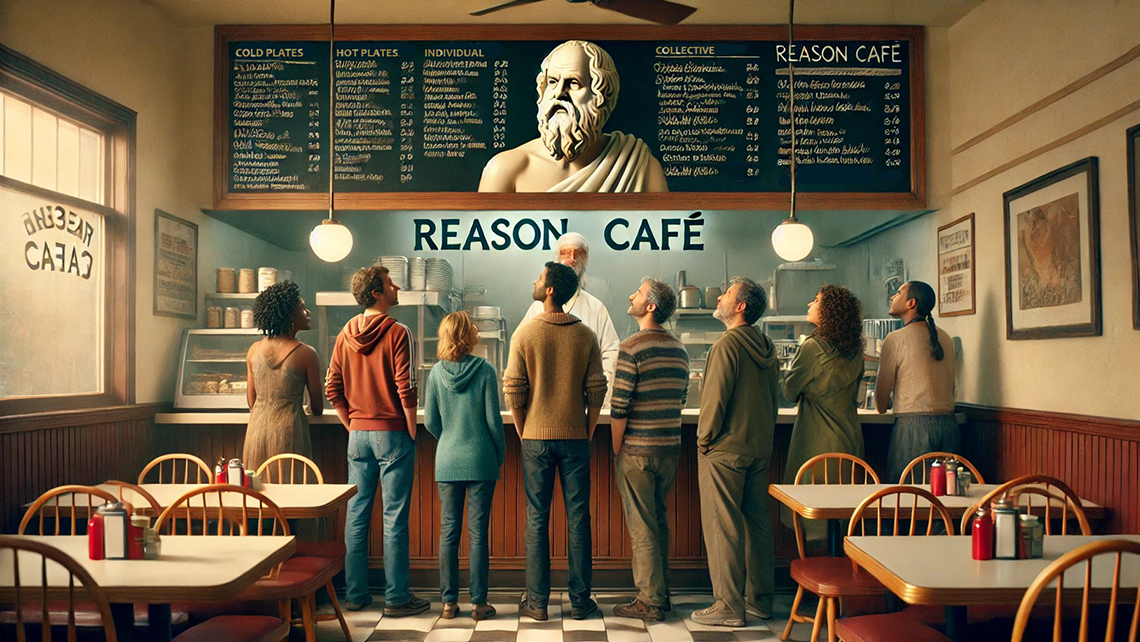
While individual reason is more often used to support an emotional desire than regulate it, reasoning collectively can produce progress by making a beneficial behavior more desirable for individual elephants than a detrimental one. Journalist and author Julian Baggini coined the terms “hot reason” and “cold reason.” Hot reason is what Kahneman calls system 1 (and what Jonathan Haidt calls “intuition”) and cold is Kahneman’s system 2. This “hot and cold” categorization allows us to expand reason into an ecosystem comprised of four types:
- Individual hot reason, those quick assessments that pop into your head.
- Individual cold reason where you employ logic and critical thinking on your own.
- Collective hot reason, when a group quickly coalesces around a belief or proposition. While this is often associated with negative things like mob mentality and the dehumanization of “others” it also includes positive things like empathy and compassion.
- Collective cold reason is when propositions are reviewed by a group to mitigate individual biases and cognitive blind spots. This is the engine of human progress; it is how and why we have thrived as a species. The longer, more comfortable lives we lead are the result of centuries of cold, collective reason.
The example of smoking illustrates how reason’s ecosystem functions. At the end of WWII, hot reason ruled the roost. Individuals believed in what their individual hot reason told them about smoking and were supported by broad collective hot reason that smoking was a perfectly acceptable, even glamorous, habit. Smoking is a social activity with a bevy of rituals attached to it that forges connections and shared experiences (I remember my ex-wife telling me that asking for a cigarette, or just a light, was a great way to break the ice with someone you find attractive. In hindsight, I guess I should have seen this as a red flag.) What all those elephant herders accomplished was to change smoking for many people from being something which enhanced and enriched their social lives to something more isolating. Batting your eyes at someone and asking for a light in a lively bar or club is a lot more appealing than being forced to stand outside on a cold sidewalk huddled together with a small handful of other nicotine-addicted outcasts.
The contrast between Hume’s passionate skepticism and Kant’s idealistic confidence underscores the complexity of reason’s role in human decision-making. Both, however, focus too much on individual cold reason. While this type of contemplation can—and should—be part of one’s self-exploration, we must remain humble about its limits. Individual reason often bends to the will of our emotions, but collective reason has the transformative power to shape social norms and influence behavior. The battle against smoking shows how cold, collective reason can turn individual limitations into societal shifts, using the strength of system 1 elephants to guide individual riders who struggle to get there on their own. As we face modern challenges like climate change, threats to democracy, and navigating artificial intelligence, the same kind of collective reasoning will be essential in driving cultural change. While we should all strive to improve our personal reasoning skills, it is the embrace and support of collective reason that will bring the most progress for future generations. The world needs more elephant herders—but only a select few possess the empathy, humility, and self-awareness required. At its core, New Atenism is a community of elephant herders. If you think you have what it takes, please join us!
[1] Published by Farrar, Straus and Giroux in 2011