
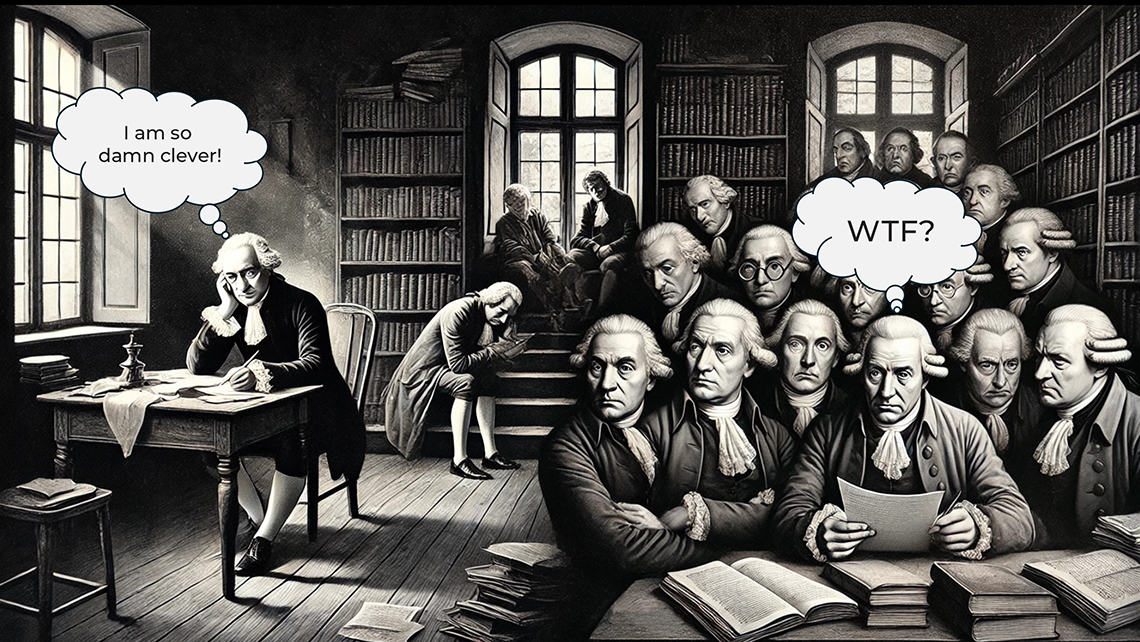
If you want a book that reminds you how little you know — and how much you depend on others — Immanuel Kant’s Critique of Pure Reason is hard to beat. First published in 1781, it is widely considered one of the most significant and complex works in the history of philosophy. For this reason, understanding it is deemed by many to be a requirement to claim a certain intellectual status. The problem is that Critique is also considered to be one of the most impenetrable and dense works ever written. I suspect many have claimed familiarity with Critique in search of that intellectual status even they couldn’t make heads or tails out of it.
I’ll admit at the outset that my own attempt to read it was a dismal failure. As we’ll see, this puts me in good company as this is the same experience philosophers and academics in Kant’s time had at its initial publication. Fortunately, that initial criticism drove Kant to refine and clarify his ideas in a subsequent work called “Prolegomena to Any Future Metaphysics.” This is the story of how the brilliant insights Kant developed in isolation using his extraordinary powers of individual reason required collective reason to make them accessible to other domain experts, who in turn have made them accessible to the rest of us. This is a story about the power of reason’s ecosystem.
Kant may have assumed that what was clear in his own mind would be clear on the page. In modern psychology, Steven Pinker calls this “the curse of knowledge”: once you know something, it becomes almost impossible to remember what it’s like not to know it. Critique of Pure Reason could have become a tragic casualty of this curse if it hadn’t been rescued by collective reason. Kant believed he was communicating carefully, but without testing his ideas on others before publication he had no way of seeing how opaque they would appear to readers.
It’s impossible to know, but it’s worth asking whether Critique alone would have secured his legacy. If Kant hadn’t published Prolegomena and let Critique stand or fall on its own, would it, and he, be as highly regarded as it is today? Those who dismissed Critique initially did not have the benefit of Prolegomena–not to mention, more than 240 years of study, lectures, publications and YouTube videos–to facilitate their understanding of Critique’s concepts. Perhaps it would have been resurrected like Vivaldi by some ambitious PhD candidate and still achieved its current status, but perhaps not. In either event, I argue that collective reason, and particularly its culture of criticism, was a key component to Kant and Critique ending up on the high pedestal they now occupy.
To lean even more into my own knowledge humility, I must further confess that while helpful, “Prolegomena” didn’t succeed in making the concepts of Critique all that clear to me either. Most of my understanding of Kant required another level of dumbing down and modernization by contemporary Kant experts. Key Kantian concepts like transcendental idealism, where he distinguishes between appearances, which we can know, and things-in-themselves, which remain beyond our grasp, his categorization of knowledge (a priori/a posteriori & synthetic/ analytic) and his belief that universal moral truths (categorical imperatives) can be discerned by any rational person, came more from contemporary sources than my direct absorption of his writing. This information chain can be viewed as a pyramid.
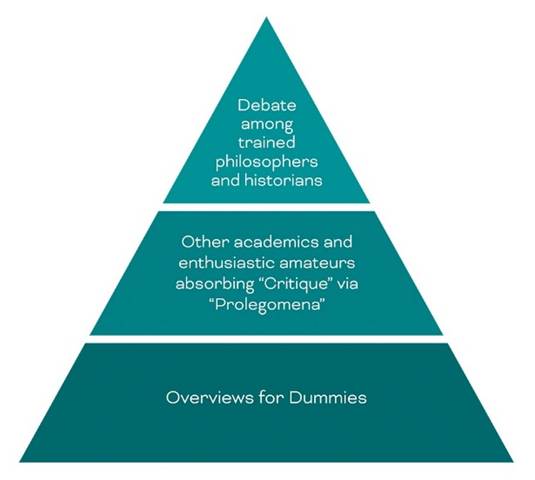
At the top of this pyramid lies a small number of people who have read Critique of Pure Reason and are able to more or less fully understand not only its contents but its place in the history of philosophy. The fact that only a handful of specialists can fully parse Critique directly is less a testament to its depth than to the curse of knowledge. Kant wrote as if his audience already shared his intellectual scaffolding. Collective reason has worked for two centuries to translate, annotate, and simplify, building a “knowledge pyramid” that makes at least some of his insights accessible to the rest of us.
Even today, Kant’s book intimidates professionals. In a recent discussion between two Cambridge-trained philosophers, Alex O’Conner admitted he was ‘terrified’ of reading Critique, while Joe Folley praised its brilliance but described it as “hard going” and recommended the use of “secondary literature” (aka the middle of the pyramid).
By publishing Prolegomena, Kant spread his ideas to the intellectual community of his time who in turn spread them across and down the pyramid — eventually reaching folks like me who need a lot of hand-holding. This “knowledge pyramid” illustrates how collective reason works: a few specialists wrestle with the original text, and their interpretations cascade downward through scholars, teachers, and popularizers until the rest of us can access it. Rather than a rigid hierarchy, think of this pyramid as a system of translation: ideas distilled at the top spread outward and downward, enriching the entire base.
For all the praise it now receives, Kant’s magnum opus did not get a whole lot of love when it was first published. Christian Garve and Heinrich Feder published a review which characterized Kant’s philosophy as overly abstract and incomprehensible. Most annoying to Kant, Garve and Feder dismissed Critique as simply another version of the idealism of George Berkeley, a notion Kant vehemently rejected as Berkeley’s view that perception is reality was diametrically opposed to Kant’s that we can never perceive “true” reality. Even Kant’s close friend, theologian, mathematician and philosopher, Johann Friedrich Schultz, who became a staunch defender of Critique, acknowledged that the public saw it as a “sealed book” consisting in nothing but “hieroglyphics.”
The Garve–Feder review, scathing and mistaken though it was, performed the classic corrective function of collective reason: it broke through Kant’s curse of knowledge. Their misinterpretation revealed that what was obvious to him was not obvious to others. Stung, Kant responded in Prolegomena — a clearer, more accessible restatement that included an appendix widely read as a direct rebuttal to Garve-Feder. Prolegomena was the first step in the construction of the knowledge pyramid which has made Kant’s ideas accessible to anyone and everyone.
This story is a powerful example of the difference, and the relationship, between individual and collective reason. Kant regularly hosted gatherings at his home in Königsberg, engaging with colleagues and students in lively discussions about philosophy, science, and politics. That these discussions were an important part of Kant’s intellectual life makes it odd that it doesn’t seem to have been a part of the process of creating Critique. Perhaps confidence in his intellect led him to believe his ideas would speak for themselves, or perhaps he simply underestimated the value of feedback.
Whatever Kant’s headspace was, the story of Critique underscores a larger theme about the power of collective reasoning: no matter how intelligent or reasonable one individual might be, engaging with external feedback can sharpen ideas, address blind spots, and lead to clearer communication. Kant’s story is a perfect illustration of how even the sharpest individual reasoning tools benefit from collective criticism. By writing in isolation, Kant missed an opportunity to refine his arguments through dialogue and criticism. This overconfidence in his own reasoning likely contributed to the impenetrable nature of Critique, which alienated many contemporary readers. Had he embraced the collaborative process of collective reason during the writing of Critique, the work might have been clearer, more accessible, and better received.
Kant’s genius was never in doubt, but his failure to anticipate how others would read his work could have greatly reduced its impact or even consigned it to obscurity. The curse of knowledge blinded him to his audience. Only collective criticism pulled him back, forcing him to clarify, simplify, and re-articulate. His story is a reminder that even the sharpest minds can’t escape the curse alone; they need the corrective lens of others.
Kant’s Critique of Pure Reason is both a testament to the power of individual reason and a reminder of its limits. While Kant’s isolation allowed him to develop a rigorous, comprehensive philosophical system, it also prevented him from benefiting from the feedback and criticism of others—a process that would have undoubtedly improved the clarity and accessibility of his work. The initial struggles with Critique’s reception serve as a cautionary tale for all thinkers: no matter how brilliant one’s ideas may be, they can only be fully realized and appreciated when subjected to the scrutiny of others.
This lesson isn’t just for philosophers. Whether you’re writing code, policy, or a blog post, the curse of knowledge will blind you. Only collective criticism ensures your ideas survive and spread – just as it did for Kant.