How to Become a CEO of Human Knowledge
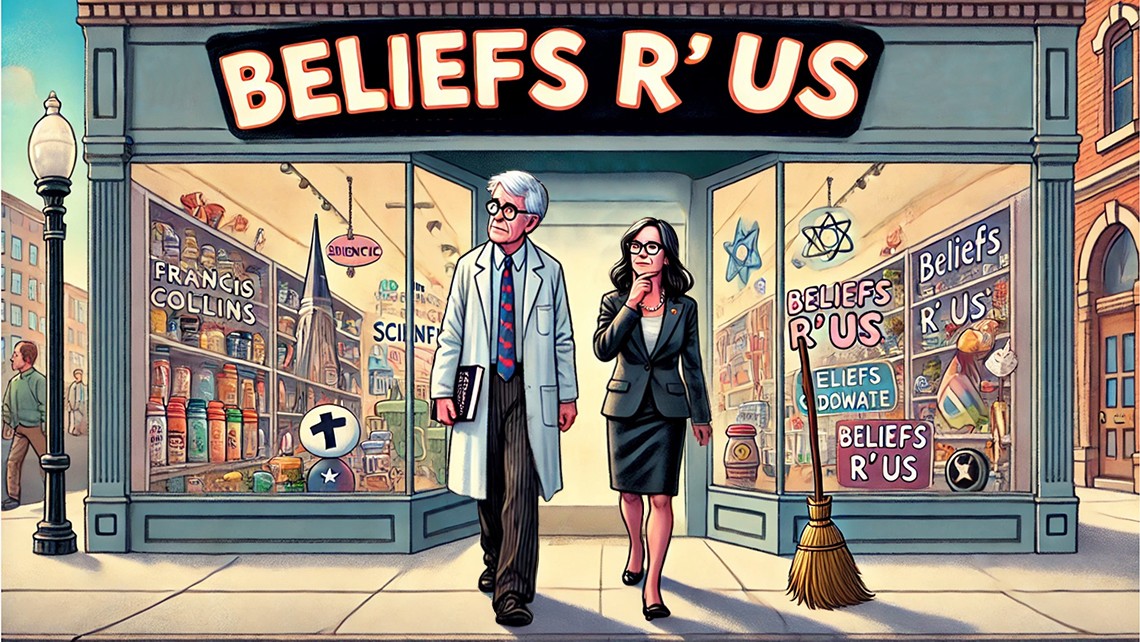
Christine O’Donnell and Francis Collins walk into a store…
This is the first line, not of a joke, but rather of a story designed to illustrate something about belief and knowledge. Our story will be about evolution, but before we begin, a little background on our two characters.
Christine O’Donnell ran for the Senate in Delaware in 2006, 2008 and 2010. In addition to distinguishing herself as a candidate for national office by publicly denying she was a witch[1], Ms. O’Donnell once demanded to know why “if evolution is true, why aren’t the monkeys in the zoo turning into humans?” She is hardly alone among creationists who employ the “since I can’t see evolution happening with my own eyes, it isn’t happening” argument. For Ms. O’Donnell, “unexplainable” is anything she doesn’t understand and she’s unwilling to accept the explanations of snotty elitists in lab coats whose measurements and analysis are beyond her. Speaking of elite people in lab coats, Dr. Francis Collins spent decades of his life earning multiple advanced degrees, including an MS & PhD from Yale and an MD from the University of North Carolina. After all that education he worked for years in molecular genetics, held positions including Director of the Human Genome project and Director of the National Institute of Health (NIH) and, prior to his retirement in 2022, served as Science Advisor to US President Joe Biden.
As different as these two people are, there is a belief they share. Both believe that the God of the Christian Bible created the universe and came to Earth in the human form of Jesus to show us that eternal life and victory over sin are possible.
And now, back to our story…
Dr. Collins and Ms. O’Donnell have just entered the largest store in the known universe called “Beliefs R’ Us.” They find their way to the evolution section where they come upon two products sitting on the shelf. The first one is called “Official Biblical God Made Humans Belief Kit!” and the second “An At-Home Course for Becoming an Evolution Domain Expert!” Ms. O’Donnell takes the first package off the shelf to read a bit further. “Learn how God, the almighty creator of the universe, created man in his own image and gave him dominion over every living thing that moves on Earth![2]” Sold! Perhaps feeling a bit self-conscious to be standing next to one of the world’s most respected scientists (although, honestly, this seems unlikely) she gingerly picks up the second package. “In just ten short years, this kit will take you on a journey of discovery through the biology, geology, chemistry, paleontology, ontogeny, phylogeny and other sciences required to fully understand evolution. In addition, you’ll learn the advanced mathematics required to evaluate the radiocarbon dating and DNA analysis of fossils. Included in this kit are millions of pages of experimental results which, after completing this course, you will be able to analyze yourself over the next ten years! To ensure your personal biases don’t skew your results they will be reviewed by other purchasers of this product who will helpfully point out everything you got wrong! In just 20 years you’ll become a true evolution domain expert, able to shut down your annoying uncle’s creationist diatribes at Thanksgiving dinner–provided he’s still alive once you’ve completed the course. (20 years is an estimate, your results may vary).”
Dr. Collins smiles at her. “This is a terrific product, I’ve been using it for 40 years and swear by it.”
She places it back on the shelf and clutches the God Made Humans kit a little closer to her breast. “No thanks, I’ll stick with this one.”
He nods, “Yes, it certainly was a lot of work and it’s not for everyone.” He grabs another product off the shelf. “You might consider this one.”
She reads the package. “How to Become the CEO of Human Knowledge! Humans know too much stuff. Countless experts over the centuries have amassed a library of knowledge far beyond the capacity of any one person. By believing in the power of reason, you can leverage all that expertise and get all those brilliant people to work for you! Right now, millions of experts around the world are feverishly working, and checking each others’ work, to acquire new knowledge to present to you. No more feeling bad that you don’t know everything!”
She looks at him skeptically.
He shrugs. “Hey, I’m not saying that being a CEO is easy, it isn’t. Figuring out the right questions to ask, when you need to dig in and evaluate the evidence yourself and when you need to step back and let the experts hash it out and, perhaps most importantly, what you should do to support the efforts of all those experts, is tough. It is possible to be a successful hands-off CEO and accept expert conclusions with little meddling. Others like to be a bit more hands-on, being skeptical, asking questions and seeking evidence and coherent explanations. The world needs both types of CEOs.”
“You, a God-fearing man, actually use this?”
“I do. While I’m a happy customer of the evolution domain expert kit, I’ve had to rely on the power of reason to find the best explanations in every other domain. I mean, just look at the endless shelves in this store!”
“I can’t see over the shelf in front of me.”
“Oh, there’s a step ladder right there.”
“No thank you.”
* * *
This little story/thought experiment may seem simplistic but it represents a choice we all make constantly : 1) accept what authority, your own urges and assumptions or what your social group tells you, 2) apply the process of reason yourself and acquire the knowledge required to perform your own analysis or 3) believe in the power of reason to leverage the totality of acquired human knowledge and the ongoing work of domain experts across the globe. With option three you can often acquire answers quickly enough to satisfy your belief engine while utilizing the process of reason’s vastly superior truth-finding capability. Dr. Collins purchased the At Home Evolution kit but for virtually every other product on the endless shelves of the Human Knowledge store, he purchased, and heartily endorses, the CEO of Human Knowledge product. He believes in the power of reason to develop and verify knowledge beyond his understanding, and we should too.
What I find fascinating about Dr. Collins is that a man who has devoted his life to reason believes in a particular set of supernatural explanations for things reason has not yet revealed. Even someone as intelligent and learned as he is can still have his reasoning subverted by his emotional desire to believe something. Dr. Collins, in his book, “The Language of God: A Scientist Presents Evidence for Belief,” makes a reasoned argument in support of, among other supernatural concepts, the divinity of Jesus. A centerpiece of this argument, and his personal conversion to Christianity, is C.S. Lewis’ famous “trilemma,” that for Jesus to say what he said he would have to have been either a “lunatic, liar or lord.” While there is significant scholarly debate about whether Jesus actually did claim to be God, neither Lewis or Collins included a fourth, and more likely, option; that Jesus was a revered, but completely human, rabbi and teacher who was elevated to divine status by followers after his death.
Regular readers of this blog and/or the New Atenism book will be familiar with Jonathan Haidt’s description of how we form beliefs as a rational rider atop an emotional/instinctual elephant. Haidt’s analogy is intended to explain how our emotional elephant is usually in charge of our rational rider: “Intuition comes first and reason second.[3]” I would argue that Dr. Collins’ elephant has a strong enough desire to believe the Christian narrative that it hijacks his rational rider into making reasonable sounding arguments which support that belief. These are arguments he would reject in a scientific setting, but his rider solves this conflict, by viewing science and the Bible as “two books” that God has given us which are meant to teach us about different things.
When he comes to the wall at the end of the human knowledge store, however, he imagines that the creator of the universe is behind it. With each new piece of knowledge humanity acquires, that wall moves a bit further out and Dr. Collins takes a step forward, still believing that the God of the Bible is just on the other side. Even though Dr. Collins embraces the power of reason and Ms. O’Donnell, whether she knows it or not, clearly rejects it, they both accept supernatural explanations for phenomena beyond their understanding. This does not make them birds of a feather, far from it. Dr. Collins is a distinguished scientist who has made major contributions to human progress and Ms. O’Donnell, again, whether she knows it or not, fiercely advocates moving humanity backwards.
My intent here is not to beat up Dr. Collins, a true champion of reason who has made major contributions to human progress and flourishing. What Dr. Collins illustrates is the powerful allure of supernatural beliefs. In his most recent book, he describes truth as “the objective reality that is independent of human perception” and science as “the systematic search for truth through observation, experimentation, and empirical evidence.” So far, he could be sitting right next to me in a New Atenist pew. Our fork in the road happens with his views on faith and trust. He equates his trust in the power of reason to sort fact from fiction in science, which is supported by mountains of evidence, with his trust in the Christian narrative which is unsupported by evidence. To trust that a particular divine revelation actually took place requires the subjugation of reason whereas trusting that the best explanations will emerge from the culture of criticism is to embrace it. I’m a great admirer of Dr. Collins and I hope one day to be able to have a conversation with him about his beliefs.
* * *
The knowledge CEO mindset is another way to view how our tiny slice of individual knowledge can access and utilize the vast canon of collective knowledge. By believing in the power of reason you delegate knowledge acquisition and verification to massive teams of experts who slug it out for you. My belief in the age of the Earth and universe, the relative safety and efficacy of vaccines, that genetically modified foods are not only safe to eat but vital to feeding a planet of 8 billion people, that putting fluoride in the water supply poses minimal health risks which are greatly outweighed by reductions in dental problems, that human activity is driving climate change and that the more advanced a civilization the more its citizens prosper are all rooted in my belief in the power and process of reason. I’m not an expert in any of these fields but I’m confident in the collective results the experts hammered out. My belief in the power of reason means I get the benefits of knowledge without having to do the work. How awesome is that?
By placing your belief in the power of reason you leverage the massive effort by millions of experts over the ages to formulate human knowledge, confident that the process of reason has, and will continue to, weed out bad explanations. The more humans who believe in reason’s power, the more knowledge we’ll acquire, the more progress we’ll achieve and the more we’ll foster belief in reason.
For most of human history, the only product on the shelf was blind faith. Religious or political authorities told us what to believe and that was that. The Enlightenment dramatically increased the reach of that second product, reason-based knowledge. Rejecting authority and relying upon evidence improved our ability to determine what was true and what wasn’t. At the time of the Enlightenment, there were people well versed in all areas of human knowledge, often referred to as “Renaissance persons,[4]” but today, no one person can be an expert in everything—although many of us suffer from what I call “Google-enhanced Renaissance person delusion,” the misguided belief that a quick internet search can make you a domain expert in any subject. Today, no matter how much knowledge you have in a specific domain, you must rely on the power of reason and the culture of criticism to sort the wheat from the chaff in every other domain. There is now too much collective knowledge to let faith or authority reign over our beliefs. Knowledge drives human progress, and the process of reason is what drives knowledge.
[1] Ms. O’Donnell during her unsuccessful 2010 Senate run attempted to “clarify” remarks she made on Bill Maher’s talk show that she “dabbled into witchcraft” and “one of my first dates with a witch was on a satanic altar…”. She ran an ad where she stated “I’m not a witch. I’m nothing you’ve heard. I’m you.”
[2] Genesis 1 verse 26
[3] “The Righteous Mind: Why Good People are Divided by Politics and Religion” Jonathan Haidt, Pantheon Books 2012
[4] At the risk of being accused of rewriting history, I’m intentionally rejecting the patriarchal term “Renaissance Man” out of respect for the women in the age of reason who were versed in science, mathematics, philosophy and art, including Emilie du Chatelet (1706 – 1749) who penned a still in use today French translation of Isaac Newton’s Principia, Caroline Herschel (1750 – 1848) who discovered 8 comets and various nebulae and star clusters and Mary Anning (1799 – 1847) who discovered hundreds of Jurassic-age fossils. There were many others.