Breakfast in Civilization Part VI: Three Women in 2026
Emeryville, California
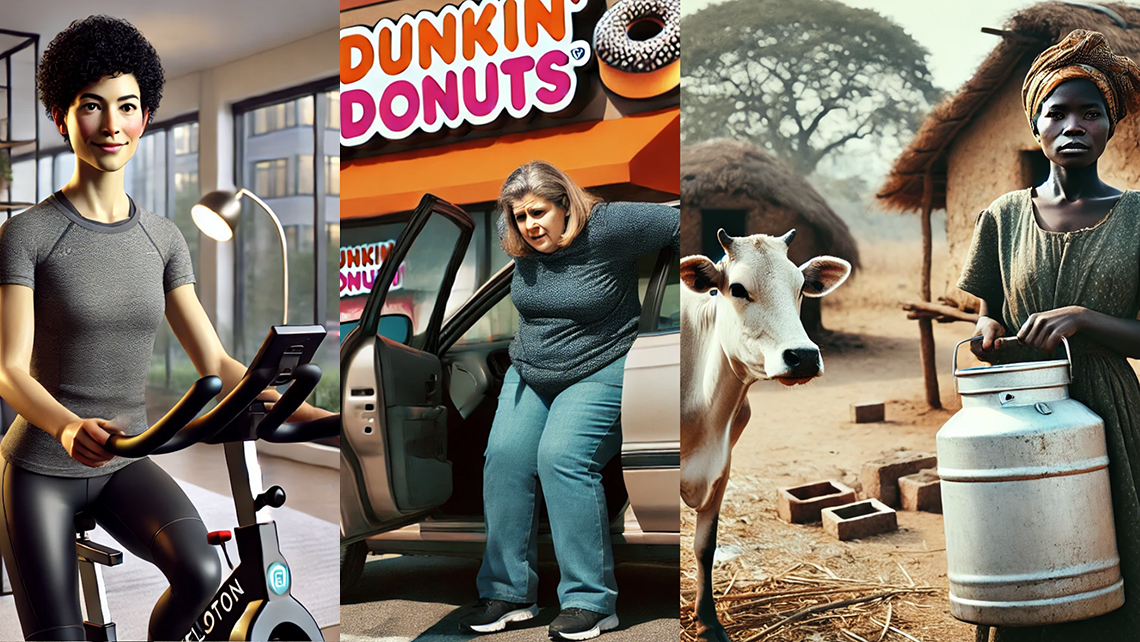
Soft music from the phone on her nightstand lifts her from a deep sleep to drowsy semi-awareness. As the volume of the music grows, she’s pulled into the present and silences the phone before it wakes her wife. She slips out from under the covers, out of the bedroom and into the guest bathroom where she laid out her exercise clothes the night before. After changing, she heads down to the kitchen where the coffeemaker, following the instructions of the same digital assistant that turned the heat on ten minutes before her alarm sounded, had just brewed a fresh pot. She opens the fridge and selects the “Power-food Breakfast” container, one of 10 pre-made meals that get delivered to their home each week from a local organic farm to table distributor. Placing it on the counter so it won’t be ice cold when she finishes her workout, she feels like she’s had it a lot lately. She grabs her phone and with a few clicks adds “Blueberry Bomb Oatmeal” and “Yogurt & Grain Medley” to next week’s delivery. Looking out the sliding glass doors to their small patio, she thinks their aloe vera plant is looking a bit pale and she wonders if the drip irrigation they set up is providing enough water. Another quick note on her phone will remind her to hand water it.
They had purchased this 2-bedroom townhome three years ago for just over nine-hundred thousand dollars. It seemed an outrageous price at the time, especially given that it was in Emeryville, across the bay from San Francisco where both of them worked. It was now, according to their realtor friend, worth closer to one and a half million. Now 33, she never really had the powerful “baby bug” so many women her age talk about, but she did feel like it was time to start a family. They wanted two children. She would carry the first one and her wife the second using the same sperm doner, a close friend.
While they might squeeze a newborn into their current home, their growing family would need more room. Three or four-bedroom houses with yards in nearby neighborhoods which interested them were going for two and a half to three million. Too much for them despite their combined income of nearly five hundred thousand. The startup where her wife worked as a full-stack web developer, had planned to go public or be acquired, which would likely have provided enough cash to write a check for a house like that, but a recent weakening in sales, combined with management manipulations that reduced the value of her wife’s stock options, had caused this dream to fade.
Ironically, the Covid-19 pandemic had produced another option. Being forced to work from home demonstrated that they could be just as productive, if not more so. Even her micro-managing boss had to admit that remote work hadn’t reduced productivity. This dramatically expanded to scope of where they could live. They had started to look at options ranging from further on the outskirts of the San Francisco Bay Area, Santa Cruz, Portland Oregon and even Boise Idaho. Seeing the amazing homes two million dollars could get them in some of these places was intoxicating.
She put the empty coffee cup in the sink and grabbed a bottle of spring water from the fridge. Wheeling her Peloton stationary bike from a corner to the middle of the living room, she climbed aboard and loaded a class from her favorite instructor. She was determined to hit a new personal best for power output. As she went through the warmup routine, her gaze drifted over to the framed wedding photo on the mantle above the fireplace. She and her wife are standing with their parents in front of her family’s church in Swarthmore, just outside of Philadelphia. They agreed to be married in the church despite the way she was shunned when she came out at 14. Her family had always been supportive, but she would never forget the exclusion, hate, and promises of eternal damnation she’d received from some church members. This no doubt contributed to her loss of faith in her first year of college.
She snaps out of the memory at the command “Get up out of that saddle and work it!”
Atlanta, Georgia
Her cellphone wakes her at 5:30 AM sharp. Her shift at the Globexa[1] Fulfillment Center outside Atlanta begins at 7AM and she wants to be sure she punches in on time. Globexa’s systems track virtually everything she does and generate regular evaluations. She has a human boss who does speak to her from time to time, but it’s a machine that runs her work life. Her husband doesn’t have to get to his construction job until 8:30 so he’ll drop off their 3-year-old at her mom’s and their seven-year-old at school. She’s grateful that her husband’s working regularly again after being unemployed for almost all of 2020 and struggling to find regular work through 2021. Even though he’d received enhanced unemployment benefits during the pandemic, and she was able to rack a lot of overtime as Globexa’s business exploded, their income had only recently recovered. Still, she knew the pandemic had been far worse for many. Two of her friends were facing eviction from their homes. Both were working again after losing their jobs and had been able to stay in their homes due to the Covid-moratorium on evictions but haven’t been able to cover the back rent that became due the minute the moratorium expired.
The rent on their 3-bedroom, 2-bath house was $1,800, which was manageable for them but didn’t leave much room for savings. Globexa has a 401k retirement plan but she’d had to pull money out of it incurring a nasty and unexpected tax bill.
She parks her 12-year-old Toyota Camry in the Dunkin’ Donuts lot and gingerly climbs out of her car so as not to aggravate her sore back. Globexa provides her with medical insurance, but the deductibles and co-pays keep her away from the doctor for anything short of an emergency. She orders a coffee and a cinnamon twist. She knows she should get something healthier as her doctor told her at her last checkup—checkups being one of the few things that insurance covers 100%–that she was borderline diabetic. But $3 for a breakfast with coffee that she can savor for the last few miles of her commute—pretty much her only “me time”—is not something she’s willing to give up.
She’d grown up just north of Atlanta, not far from here. Her father and his father had worked at the GM factory in Doraville. Grandpa had earned enough to buy a home that his GM pension allowed him to comfortably retire in. She and her two brothers grew up in the modest house their parents were able to afford, with the help of her mother’s income as a school librarian. When GM closed the plant in 2008, they offered her father, then 53, an incentive to retire early. Now her parents were getting by, but just barely, on their smaller pensions and social security. She knew the only way she’d ever own a home would be to inherit that family home, but she had no idea how she’d ever come up with the money to buy out her brothers.
Seeing the decline of living standards in the generations of her family made her angry. It seemed like nobody cared about regular Americans anymore. She’d read that Globexa’s owner, Rex Vanner, was worth over $200 billion and that was after giving the ex-wife he cheated on $40 billion. How was it fair that he could be so rich, when workers like her who made him rich were struggling? Her husband complained every day about how the construction companies were using more and more Mexicans and wondered when they’d just toss him aside in favor of that cheap labor flowing over the Southern border. They were deeply faithful church goers who loved America and what it stands for, and they seethed with resentment at those were destroying the American dream.
Rural Zambia
Waking a bit before dawn, she picks up her 5-month-old daughter from the straw bed they share. She carefully places her next to her still sleeping seven-year-old son, who’ll look after her while she milks the family’s four cows. These cows are the offspring from the three pregnant heifers gifted to them by People in Need, five years ago. That gift lifted her family up from the brink of starvation and she will always be grateful. It gave her deep pleasure to know that those three original cows were now doing the same for another family. Her husband is already up and out preparing for his day tending to their modest corn field. She grabs the two 20-litre milk pails she fills each morning and heads to the cow pen. After filling both pails, she’ll have more than enough milk left over for the family breakfast.
With the milking complete, she attaches the lids and mounts it on the sturdy racks that frame the rear wheel of her bicycle. The bike was given to her by the World Bicycle Relief Fund[2]. It’s a bit more than five miles to the dairy depot where she sells her milk, which used to be a three-hour walk pushing the nearly 100 pound load on a clumsy cart. On the bike, she makes it there in 40 minutes and, because the milk is fresher, she’s able to get a better price for it. Even better, she can now milk her cows in the afternoon and make a second trip. She used to earn less than $15 per month selling her milk but now often earns as much as $50.
Before setting out on the ride along the unpaved roads to the depot, she takes the broad pan containing the leftover milk back to their one room hut. Her son and infant daughter are now awake, and she takes her daughter from him and puts her in the backpack she fashioned herself. She calls to her husband to come join them. She mixes the milk with sweet potatoes and fruit they’ve grown into a sort of porridge and serves it along with some sausage they got by trading corn they grew to a local pig farmer who uses it for feed. As they eat, her husband tells her that their gravity-based irrigation system is still not providing enough water, but a neighbor will stop by today to help him fix it.
As she begins to ride towards the dairy depot the still rising sun paints the sparse clouds with a palette of deep reds, to pale pinks and grays. She feels hope for the future.
* * *
This series of breakfast stories illustrates how life for humans has progressed over the centuries. There are four ages; pre-civilization hunter-gather, agriculture, enlightenment/industrial revolution and information, which are punctuated by massive leaps in human knowledge. There is also a pattern which emerges where the quality of human life progresses during one age, then a leap forward in human knowledge causes a near-term decline in the quality of life for a significant portion, but a huge increase for some, and then over time the benefits are shared by nearly everyone. This is followed by the next leap forward where the cycle repeats. This is not to say that all is rosy for everyone, but rather that overall, the lives of humans grow longer and more comfortable. We must not shrug off the horrific life of the immigrant who worked in Carnegie’s steel plant in 1900 or the struggles of that contemporary Globexa employee. The fact that this early pain led to massive gains in progress for our species does not mean that we should not strive to do a better job of mitigating those negatively impacted in the near-term. According to the World Bank, worldwide per-capita GDP has risen from $3,500 in 1990 to nearly $12,000 in 2021 (adjusted for inflation and purchasing power parity). The argument that there isn’t enough to go around simply doesn’t hold up to arithmetic.
[1] “Globexa” is a fictional online retailer and should not be confused with the very real, and I’m sure very reputable, Indian immigrations service with the same name.
[2] The World Bicycle Relief Fund is a wonderful charity that not only provides life-changing bicycles to needy families, but jobs at local factories that build those bikes.