Human Perception: Our Limited Window Into Everything
I woke up with a bit of a head cold this morning. I’m now about 12 hours in to having this virus in my body, hoping it’ll last a day or two rather than a week or two. It’s a bit weird that there’s this replicating biological entity inside me whose only mission is to spread itself, make me feel like crap and infect other people. What good does this virus serve?
In addition to giving me the opportunity to whine about my lot in life, this infection also gave birth to a thought experiment about humility, the limits of human perception and inherent bias. Ironically, this involved imagining my body as the entire universe.
Assuming I live 100 years (given my father will celebrate his 103rd birthday this October, this isn’t so farfetched) the half day I’ve had this cold occupies about the same percentage of my lifetime as the 200,000 years homo sapiens have been around does of the 13.8-billion-year history of the universe.
What if humans are more like a virus the universe caught and is trying to rid itself of, than the handiwork of a benevolent creator? We’re genetically programmed to believe what is good for us is good universally, or even that what’s good for us, must be what God considers to be good.
There is plenty of evidence we’re making our little corner of the universe sicker. It is also clear that Nature is not only indifferent to our survival but relentlessly filters life through the harsh quality-control process of natural selection. The progress we’ve made in creating longer, safer, more comfortable lives has largely been about extracting more out of Nature while protecting ourselves from the ravages of its QC program. Like the cold virus I’m currently dealing with, we’re focused on thriving and replicating. Like that virus we don’t want to kill the host, ‘cause then we die too, but if it gets a little sickly while we’re partying, so be it!
We’re programmed to survive and reproduce, just like a virus is. Our powers of perception and reason were developed to support those fundamental biological instincts. While a virus has no ability to evaluate whether and how to infect someone, it’s not entirely clear that our ability to overcome instinct is much better. While satisfying emotionally to look down our runny noses at that brainless virus we must also acknowledge that it’s possible the universe, or an unknown or unknowable inhabitant of it, perceives us the same way.
The point isn’t that humanity is literally a virus or that human flourishing is bad. The point is that perspective determines judgment. From our perspective, extending human life and comfort feels self-evidently good. From another sufficiently alien perspective, humanity’s explosive growth and resource extraction might appear indistinguishable from infection.
I’m not saying that humanity is evil or that progress is bad. Quite the opposite. Wanting human beings to survive and flourish is natural, noble and deeply human. Humility begins with recognizing that our perceptions evolved to help a particular primate species survive on a small planet, not to reveal ultimate reality. The danger comes when we mistake our narrow biological interests for universal truth.
Our perceptual limitations don’t just shape how we understand the universe. They shape how we understand each other.
Every failed marriage, broken friendship, political feud and holy war contains some version of the same problem: human beings mistaking their limited perceptions for objective reality. We instinctively assume that our memories are accurate, our motives are noble, our tribe is justified and our enemies are irrational or evil.
Yet modern psychology and neuroscience increasingly suggest that much of what we experience as rational thought is actually post-hoc justification layered atop emotion, instinct and social identity.
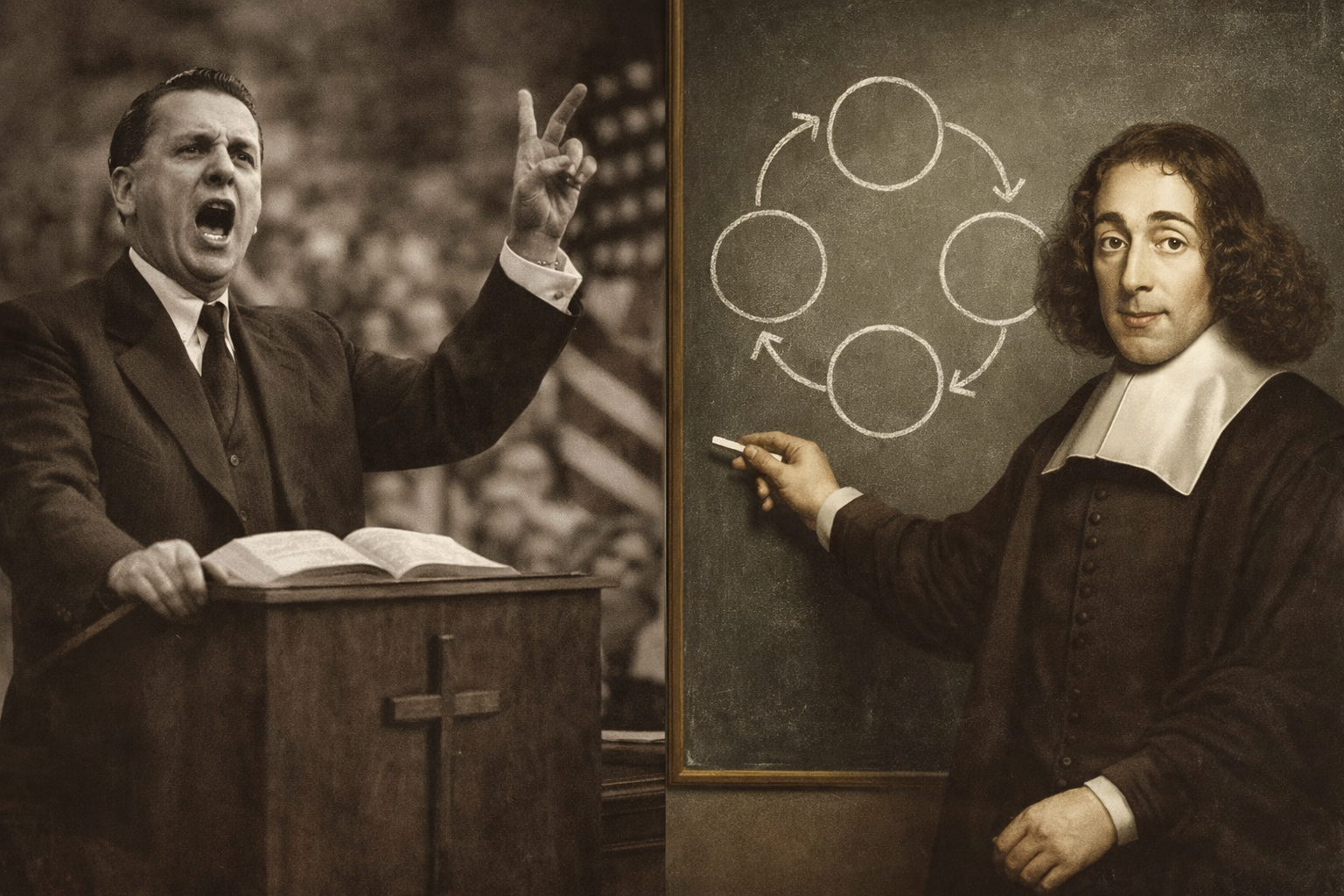
At larger scales these same perceptual limitations become civilizations, ideologies and geopolitical conflicts. Nations construct stories about themselves. Religions construct cosmologies. Political movements create moral frameworks that feel unquestionably true to their adherents because they are experienced internally rather than objectively examined externally.
The same perceptual machinery that helps us navigate daily life also attempts to answer the largest questions imaginable: Why are we here? What is good? Does God exist? What lies beyond death?
One of the most attractive things about Spinoza’s God idea is its humility. By restricting our knowledge of God to the narrow window of our perceptions, he made God both truly infinite and truly knowable. Spinoza’s God — the totality of reality itself — possesses infinite attributes beyond the two humans can perceive: thought and extension (aka mind and body). And yet, Spinoza also gave us the path toward deeper divine revelation; reason, our ongoing search for errors to produce better explanations. Each time we learn a new thing, we know one more piece of everything, about God.
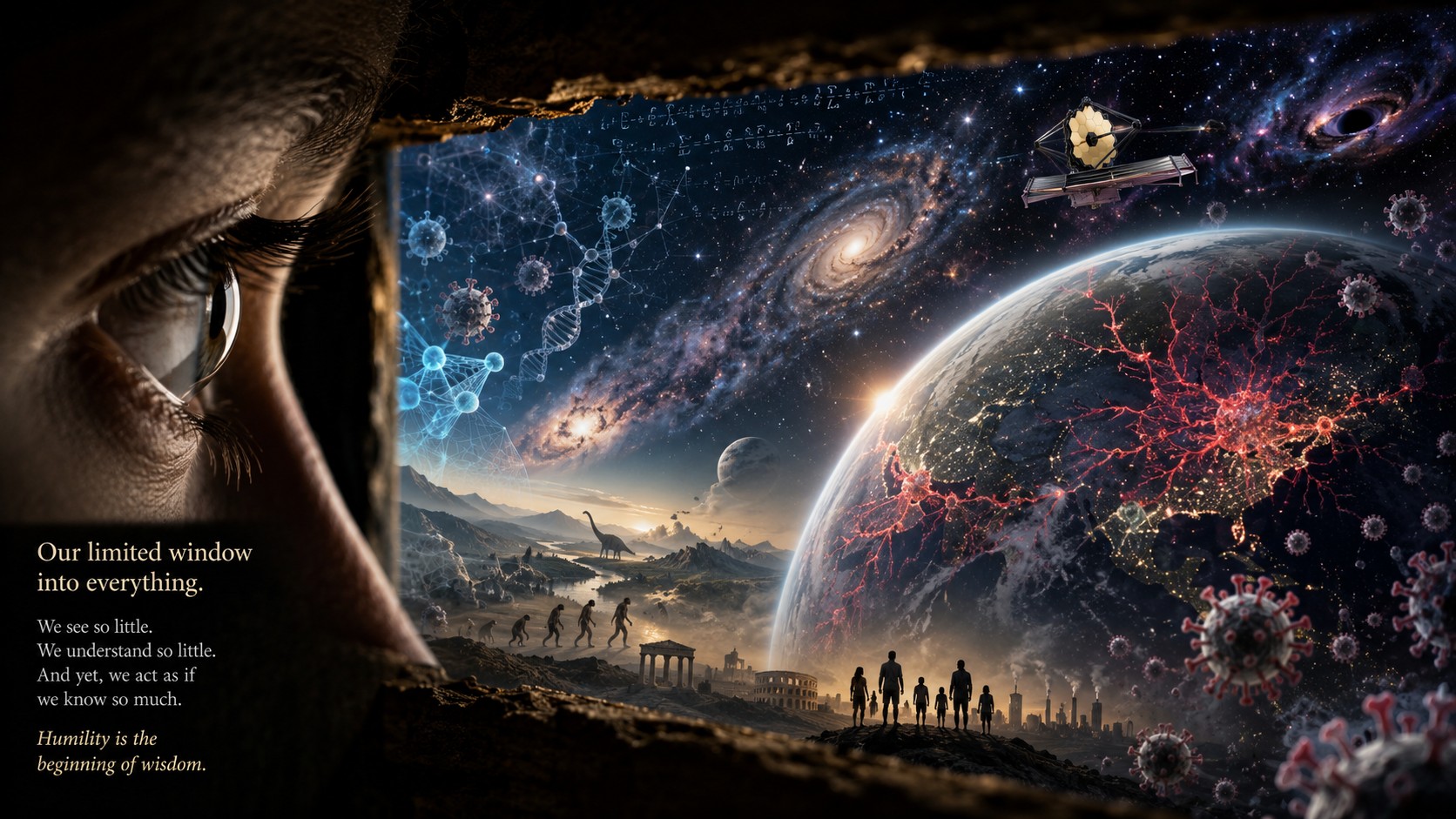
Since Spinoza’s time we have greatly enhanced our limited perceptions by developing instruments which translate things which lie outside of them into them: scanning tunneling microscopes (STMs) translate quantum behavior into a spatial, visual medium, the James Webb telescope pulls cosmic formations 13 billion years away from us in spacetime into the narrow band of our vision. These wonders push the boundaries of our perceptions outward, confirming both their limitations and reason’s ability to stretch them.
Donald Rumsfeld, former defense secretary to President GW Bush, famously said there are “known knowns, known unknowns and unknown unknowns.” While few think of Mr. Rumsfeld as a philosopher, this maps surprisingly well to Spinoza’s God idea. There are things we know we know, solid explanations reason has confirmed – think evolution, the age of the Earth and the theory of relativity. There are things we know we know we don’t know, like what happened before the Big Bang, why there is something rather than nothing and how life began on Earth. Then there are things we don’t know we don’t know, things which we currently can’t imagine or that will forever be beyond our ability to perceive or comprehend. Germs, galaxies beyond the Milky Way and quantum fields all spent most of human history in the category of unknown unknowns.
Philosophers have wrestled with these limitations for centuries. Kant argued that human beings can never perceive “true reality” directly because everything we experience is filtered through the structure of the human mind itself. Spinoza, while more optimistic about reason’s ability to reveal truth, also emphasized that human perception provides access to only a tiny fraction of reality. In modern terms, both recognized the same fundamental problem: we experience the universe through a narrow biological and cognitive window.
Today neuroscience, evolutionary biology and physics increasingly reinforce this ancient intuition. Our perceptions were not designed to reveal ultimate truth. They were shaped by natural selection to help a social primate survive long enough to reproduce.
Whether you’re considering big questions like the purpose of life or the existence of God, or small ones like whether or not you should support the construction of badly needed housing in your town, this virus analogy can be useful. Much of what you see and feel is governed by the same fundamental survival instincts that drive a cold virus: persistence, replication and self-interest.
The cold virus in my body cannot reflect on its own instincts. We can. That may be the most important difference between us.
Humility begins with recognizing that our view of reality is narrow, biased and incomplete. Wisdom begins when we stop mistaking that narrow view for the whole of reality.